“The fact that the Bible contains a lot of information – approximately 10 million bits – is central. The Nano Bible project demonstrates the miniaturization at our disposal…” -Prof. Uri Sivan
When Pope Benedict XVI visited Jerusalem in May 2009, President of the State of Israel, Shimon Peres, presented him with a very special gift. RBNI scientists worked around the clock to prepare the exhibition piece of the world’s first Nano Bible.
The over 1.2 million letters of the Hebrew Bible were etched into a silicon chip at Technion’s Zisapel Nanoelectronics Center, using a focused beam of energetic gallium ions. When the ions strike the target, they splash some atoms out of it, thereby etching into it. A holy speck of dust, the Nano Bible was mounted on a one-centimeter thick transparent stage and presented within an authentic leather cover of a full-sized Bible.
The Nano Bible was created and produced by Prof. Uri Sivan and his doctoral student Ohad Zohar
“How small can the Bible be?” Technion Nano students heard the call.
The Bible is only 0.5 square millimeters – much smaller than the head of a pin.At the Zisapel Nanoelectronics Center the text was etched with a focused beam of energetic gallium ions.
World-renowned architect Dr. Santiago Calatrava has designed a giant obelisk that marks the heart of the Technion campus. The 28-meter high kinetic sculpture is composed of 224 steel ribs on eight levels. The monument moves in a wave-like motion, in which each moving rib induces the sequential motion of the next one level at a time from top to bottom. “I designed this vertical kinetic sculpture, which integrates beauty with technique and mechanics, such that it can be seen from every place.”
“We will be able to see atoms and extract information about chemical bonds between atoms using this first-of-its-kind 4.5 meter high piece of equipment that weighs in at over 2000 kg…”
Researchers of the Technion Institute of Technology claim test will be able to differentiate between different kinds of cancers, tumors, diseases.
An innovative, simple blood test that can diagnose a variety of diseases, including cancer, has been developed by researchers at the Technion-Israel Institute of Technology and was just reported in a central article in the Proceedings of the [US] National Academy of Sciences.
Prof. Arie Admon of the biology faculty claims that the test will provide doctors with a rich variety of information that until now has not been available and is suited to the trend of “personalized medicine,” in which treatment is suited to the genetic and other characteristics of the patient. The development was part of the doctoral work of Dr. Michal Bassani- Sternberg and will help suit medication to the patient.
As opposed to current blood tests for cancer which merely note whether cancerous cells are still in the blood stream, the new test will be able to differentiate between different kinds of cancers and tumors as well as other diseases. Scientists are now working on the technique.
Admon said it was known that when the proteins in a cell deteriorate or end their roles, they are broken down into their building blocks of amino acids to create new proteins. Some of the products of this process, however, are not completely broken down and remain as pieces of short proteins called peptides.
Meanwhile, some of these peptides are displayed on the surface of the cells with help from the human leukocyte antigen (HLA) protein. When the peptides from the proteins of the disease “report” their state of health to the immune system, the immune cells kill the sick cells and prevent the spread of the disease.
The body cells not only present the HLA protein on their surfaces but also release part of these protein molecules into the bloodstream with the characteristic peptides. Cancer cells release larger amounts of the HLA protein with the peptides into the blood in an effort to “confuse” the immune system, explained Admon. Thus, the two Technion researchers reached the conclusion that by characterizing the variety of peptides linked to the HLA proteins that were released into the blood, they could diagnose cancer and other disorders.
The researchers separated the HLA proteins from the other blood proteins and then released the linked peptides. Using a mass spectrometer device, they succeeded in identifying the sequence of amino acids of the separated peptides and the original proteins that were in the cells in which the peptides were produced.
In one blood sample, thousands of different peptides can be identified, providing vital information about the disease or the tumor. There are peptides that are not present in healthy people, and when they are found, the patient can be sent for additional tests, the researchers said.
A sustainable future demands scientific solutions. Developing more efficient means to harness energy, bringing renewable energy innovations and exploring revolutionary methods for energy storage and conversion, The Grand Technion Energy Program (GTEP) is guaranteeing the future of us all.
This future demands highly-skilled graduates in energy science, and as such, GTEP has launched its unique Graduate Energy Studies Program. This is the only advanced multidisciplinary energy program in Israel, and it is also open to international students.
Global Exchange
In addition to nurturing the coming generation, international scientific collaboration with world-class researchers is vital to brainstorm the scientific power challenges. Prof. Harry Tuller of MIT recently delivered a lecture series and spoke about energy, Israel, and the challenges ahead. Global warming, pollution and astronomical increases in world energy demands were on the agenda: you can read more here.
Prof. Harry L. Tuller, MIT, at Technion as part of the Pollack Distinguished Lecture Series
This February, GTEP also hosted Professor Eicke R. Weber – Director of the Fraunhofer Institute for Solar Energy Systems ISE and Professor for Physics/Solar Energy at the Faculty of Mathematics and Physics and at the Faculty of Engineering at the Albert-Ludwigs-University of Freiburg, Germany.
Among the many exciting research projects at GTEP, one laboratory received special attention this month: the lab of GTEP Prof. Yair Ein Eli. Prof. Ein Eli has registered two patents for his innovative silicon air battery – an all-green battery alternative that uses silicon – an abundant resource – and which promises 1000s of hours of life.
While the endorsement of Technion friends means that the dream of developing the silicon air battery to create a rechargeable version for electric cars and a multitude of other applications could well be realized in coming years, first on the horizon is a new generation of batteries for hearing aids. The beauty of the silicon-air battery is that hearing-aid users will only have to change batteries once every several months – as opposed to once a week. Read more here.
Primary-school teacher Hadas Hauz – waiting for the si-air battery.
Alternative Fuels
Prof. Gideon Grader of the faculty of Chemical Engineering and Head of the Grand Technion Energy Program, discusses the development of hydrogen nitrogen alternative fuels to break our dependence on oil. Film made by the American Technion Society.
MSc. Student Davyd Wing came to Technion from Caltech to pursue the creation of polymer or organic solar cells – using a polymer-metal oxide. The advantage over conventional solar cells made of silicon is that they are easier and a lot cheaper to produce. His ambition is to create Hybrid Polymer Metal Oxide Photovoltaic Cells whose higher conductivity means they can harness the energy of the sun far more efficiently. With hands on work integrating nano-insights into potential future energy technology,Wing says research in Israel has for him an added importance.
Technion is empowering future generations of students through the GTEP graduate program in energy studies. Multidisciplinary skills and a flair for integration and cooperation makes the education of students in energy science and engineering a national priority.
The Interdisciplinary GTEP Graduate Study Program
The potential effects of new energy technologies are revolutionary, but as knowledge accumulates, challenges multiply even faster. Solutions depend upon unprecedented integration of tools and concepts originating from a wide range of science and engineering fields.
In order to train the next generation of researchers and engineers, the Technion has established an interdisciplinary graduate study program under the auspices of GTEP. This program provides the wide-ranging education necessary to discover the next generation of energy solutions. GTEP provides an environment conducive to interdisciplinary research, the resources necessary to recruit and retain the best minds, which together will generate unparalleled cross-fertilization in a stimulating environment. The Technion is uniquely suited to carry out this initiative because it has all the individual components required for success: strong engineering and basic science faculties – including aerospace, chemical, biotechnology and food, civil and environmental, architecture and town planning, electrical, materials and mechanical engineering, as well as chemistry, biology and physics.
GTEP is looking to cooperate with leading international universities on student exchange programs in the field of energy. The idea is to enable students to benefit from the developments and advances in other countries.
Managed by an interdisciplinary committee for graduate studies in energy, the GTEP Graduate Study Program is designed to attract highly motivated graduates in science and engineering who are eager to develop expertise, and provide them with the necessary infrastructure and research framework. The students are required to carry out a research project under the guidance of professors from different disciplines.
Tomorrow’s energy researchers and engineers will need to be educated in all classical science and engineering subjects, as well as know-how in economics and policy. Thus, the study program will produce scientists, engineers and researchers with a better understanding of all energy-related issues.
For detailed information on the GTEP graduate studies program click here.
From the moment we are born, and even before that, we interact with the world through movement. We move our lips to smile or to talk. We extend our hand to touch. We move our eyes to see. We wiggle, we walk, we gesture, we dance. How does our brain remember this wide range of motions? How does it learn new ones? How does it make the calculations necessary for us to grab a glass of water, neither dropping it, nor squashing it, nor missing it?
Technion Prof. Jackie Schiller and her team examined the brain at a single-neuron level to shed light on this mystery. They found that computation happens not just in the interaction between neurons (nerve cells), but within each individual neuron. Each of these cells, it turns out, is not a simple switch, but a complicated calculating machine. This discovery promises changes not only to our understanding of how the brain works, but better understanding of conditions ranging from Parkinson’s disease to autism. And if that weren’t enough, these same findings are expected to advance machine learning, offering inspiration for new architectures.
Movement is controlled by the primary motor cortex of the brain. In this area, researchers are able to pinpoint exactly which neuron(s) fire at any given moment to produce the movement we see. Prof. Schiller’s team was the first to get even closer, examining the activity not of the whole neuron as a single unit, but of its parts.
Every neuron has branched extensions called dendrites. These dendrites are in close contact with the terminals (called axons) of other nerve cells, allowing the communication between them. A signal travels from the dendrites to the cell’s body, and then transferred onwards through the axon. The number and structure of dendrites varies greatly between nerve cells, like the crown of one tree differs from the crown of another.
The particular neurons Prof. Schiller’s team focused on were the pyramidal neurons. These cells, known to be heavily involved in movement, have a large dendritic tree, with many branches, sub-branches, and sub-sub-branches. What the team discovered is that these branches do not merely pass information onwards. Each sub-sub-branch performs a calculation on the information it receives, and passes the result to the bigger sub-branch. The sub-branch than performs a calculation on the information received from all its subsidiaries, and passes that on. The result is a complex calculation performed within each individual neuron. For the first time, Prof. Schiller’s team showed that the neuron is compartmentalised, and that its branches perform calculations independently.
“We used to think of each neuron as a sort of whistle, which either toots, or doesn’t,” Prof. Schiller explains. “Instead, we are looking at a piano. Its keys can be struck simultaneously, or in sequence, producing an infinity of different tunes.” This complex symphony playing in our brains is what enables us to learn and perform an infinity of different, complex and precise movements.
Multiple neurodegenerative and neurodevelopmental disorders are likely to be linked to alterations in the neuron’s ability to process data. In Parkinson’s disease, it has been observed that the dendritic tree loses branches. In light of the new discoveries by the Technion team, we understand that as a result of that loss, the neuron’s ability to perform parallel computation is reduced. In autism, it appears the excitability of the dendritic branches is altered, resulting in the numerous effects associated with the condition. The novel understanding of how neurons work opens new research pathways with regards to these and other disorders, with the hope of their alleviation.
These same findings can also serve as an inspiration for the machine learning community. Deep neural networks, as their name suggests, attempt to create software that learns and functions somewhat similarly to a human brain. Although their advances constantly make the news, these networks are primitive compared to a living brain. A better understanding of how our brain actually works can help in designing more complex neural networks, enabling them to perform more complex tasks.
This study was led by two of Prof. Schiller’s students: Yara Otor, and Shay Achvat. Yara, an MD-PhD candidate focusing on neuroscience, was in charge of performing the experiments. Shay did the mathematical analysis of the results.
The study was partially supported by the Israeli Science Foundation, Prince funds, the Rappaport Foundation and the Zuckerman Postdoctoral Fellowship.
In peacetime, aside from his research, Professor Aviv Censor has a large following in Israel for his ultra-helpful videos explaining complex math problems for high schoolers.
Since October 7th, he’s helped Israelis down South navigate the complex logistical and other challenges after the horrific attack.
Likewise active in the Achim LeNeshek (Brothers-in-Arms) organization protesting judicial reform, Aviv took a drastic pivot just 2 days after the attacks on Gaza Envelope kibbutzes.
He took his family and moved in with friends temporarily in Le Havin, 10 minutes north of Beer Sheva, so he could help in the massive Home Front effort.
The local Achim LeNeshek headquarters were quickly converted into a logistical coordination center and Aviv and other volunteers got quickly to work.
The aftermath of the attack, aside from being beyond devastating and totally unprecedented, required a lot of help with even simple things, like armed convoys to evacuate families, bringing medicines and equipment to just-arrived army units, baby food to families who needed it.
There is a strong need to pick vegetables and fruits to prevent them going to waste.
Cows and other domestic animals need to be evacuated or cared for in difficult conditions (army equipment noise, among others).
Vets and cattle ranchers and farm volunteers need transport and other help.
Lots of other non-military needs arise each day.
Just today, he went to sit shiva with various families, to provide comfort to mourners.
The volunteer effort is a truly massive one in the South, just as in the North and Center, a testament to the resilient and helpful spirit of Israel.
The Technion community is immensely proud and supportive of Aviv and our many other volunteers, as well as reservists and soldiers on active duty.
We pray for their safety and for better times very soon.
On the morning of October 7th, Neta Portal and Santiago Perez woke up in their small apartment in Kfar Aza to the sound of warning sirens. They locked themselves in their safe room but were injured by the bullets that penetrated the door. When Santiago realized that the terrorists had thrown a grenade at the safe room door, he pushed Neta out of the window and followed her. While escaping from the apartment, they faced more gunfire from terrorists but managed to evade it and hide under one of the nearby buildings in the kibbutz. Santiago was hit in the back by a bullet, and Neta suffered seven gunshot wounds to her legs.
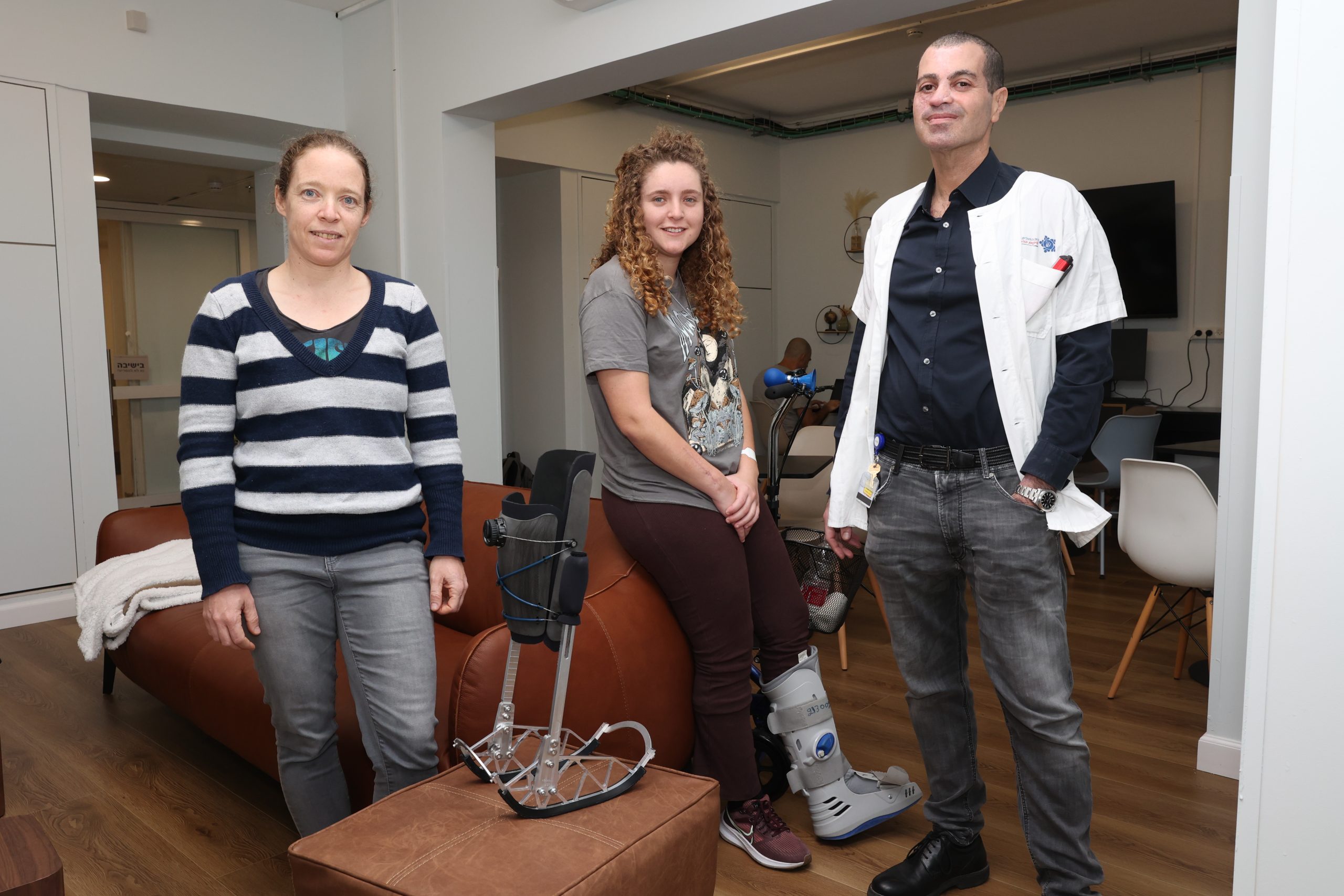
Both Neta and Santiago survived, injured but hidden, until they were rescued by Neta’s father, Deputy Chief Superintendent Shimon Portal. During her rehabilitation period at the Loewenstein Rehabilitation Center, Neta received a unique orthotic device tailored especially for her. The device will help her to walk while her severely injured ankle is unable to bear weight. The device was developed at the Technion and tailored to Neta based on a three-dimensional scan of her leg. The personalized device was built thanks to a long-standing collaboration between Dr. Dana Solav from the Technion’s Faculty of Mechanical Engineering and Dr. Amir Haim from the Loewenstein Rehabilitation Center. Both were doctoral students at the Technion under the guidance of Prof. Alon Wolf, currently dean of the Faculty of Mechanical Engineering, and have maintained a fruitful professional relationship ever since.
From left to right: Dr. Dana Solav, Neta Portal and Dr. Amir Haim
According to Dr. Solav, the purpose of the device is to enable the recovery of mobility while practicing natural and symmetrical walking under the requirement that the ankle is entirely or partially offloaded. The device effectively transfers weight to the healthy part of the leg above the injured part, allowing walking without causing pain. Moreover, it features an adjustment mechanism that facilitates a gradual and measured increase of weight-bearing of the affected part, according to the level permitted by the clinical condition.
Dr. Solav added that while walking with the device, the knee and hip joints can move and function normally, which helps prevent muscle atrophy and bone density reduction, especially in long-term rehabilitation processes. The three-dimensional scan eliminates the need for a plaster cast, and the computational design process facilitates the fabrication process, which combines a lightweight aluminum frame and 3D-printed parts.
Dr. Solav stated that in peacetime, injuries like Neta’s are uncommon. Unfortunately, in recent months, she has encountered other cases of soldiers with similar injuries. Sometimes, the injuries lead to amputation, but in many cases, doctors try to save the foot and ankle with complex surgeries, and the orthosis can improve the effectiveness of long-term rehabilitation after surgery. Additionally, they believe the orthosis can assist many diabetes patients who cannot walk due to pressure ulcers on the soles of their feet.
Dr. Solav’s research team, which consists of students and engineers, continues to develop and improve the orthosis while exploring its impact on walking. Simultaneously, the team is planning clinical trials in collaboration with Loewenstein Rehabilitation Center, and hoping to see many people improve their walking rehabilitation by using the innovative orthosis in the near future.
Dr. Dana Solav, a faculty member in the Faculty of Mechanical Engineering at the Technion, completed her MSc and PhD under the guidance of Prof. Alon Wolf and Prof. Miles Rubin, and returned to the Technion as a faculty member after completing a post-doctorate at MIT. Her laboratory focuses on biomechanical interfaces, developing medical devices that connect to the body, such as prosthetics and braces, using 3D scans, medical imaging, and computer simulations.
Dr. Amir Haim is the director of the Biomechanical Rehabilitation Unit, the chairman of the Research Authority and a senior physician in the Department of Orthopedic Rehabilitation at the Loewenstein Rehabilitation Medical Center. He is a senior lecturer at the Faculty of Medicine at Tel Aviv University and an outstanding graduate of the combined MD/PhD track at the Technion – a track where participants complete a degree in medicine and a doctorate in philosophy.