Who is Dan Shechtman?


“His discovery was extremely controversial. In the course of defending his findings, he was asked to leave his research group… However, his battle eventually forced scientists to reconsider their conception of the very nature of matter… Scientists are currently experimenting with using quasicrystals in different products such as frying pans and diesel engines.”

The Nobel Committee at the Royal Swedish Academy of Sciences

Dan Shectman in 1983, shortly after his discovery
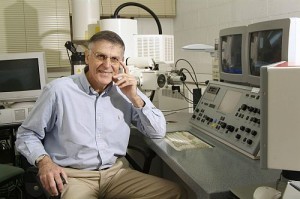
Dan Shechtman in 2010…
still unravelling the implications.


“This is the Israeli spirit. Sometimes this leads to chaos; but free thinking encourages successful scientists. We are living here in a free society… many of us do not follow the rules, and this is part of the national character of a free-thinking people.”


In 1906, 105 years ago, Dan Shechtman’s grandparents came from Russia to Israel . His grandfather, he recalls, was one of the leaders of the Labor Movement. He set up a printing house. “It was the time of the 2ndAliyah,” Shechtman told international press in Jerusalem this week, “Ninety percent subsequently left but the ten percent who stayed made Israel into the great country it is.”

Dan Shechtman was born in Tel Aviv on January 24, 1941. “I went to a youth movement – HaShomer Hatzair. In 1959, I started my military service – it was 2.5 years then. During which, I met my future wife. Then I went to Technion to study engineering. It was the dream of my life. I thought it was the best thing a man could be. I read a book in my youth by Jules Verne, The Mysterious Island. There was a character, Cyrus Smith, who could do everything. He was an engineer, and I wanted to be like him.  

Shechtman received his BSc, MSc, and PhD from Technion in 1966, 1968, and 1972, respectively. He joined the Technion Faculty of Materials Engineering in 1975, and was made Distinguished Professor in 1998. He holds the Philip Tobias Chair in Material Sciences, and heads the Louis Edelstein Centre for Quasicrystals.  “In 1975, I was offered a position at Technion. I was made a Distinguished Professor – there are some 7 and 3 of us are Nobel laureates.”

Dan Shechtman discovered the Icosahedral Phase in 1982. It is the first structure in the field of quasi-periodic crystals, and was discovered in aluminum transition metal alloys.


He instigated the course Technological Entrepreneurship in 1986, referring to it as “my baby,” and has overseen it annually ever since.  The course is offered in the winter semester each year and comprises 14 guest lectures, some of which are inspirational talks delivered by successful Israeli entrepreneurs. Shechtman is invited to lecture worldwide about the Technological Entrepreneurship course, arousing much interest. He considers himself a missionary, “I coordinate the course with pleasure. I do it for Israel.”


“This is the Israeli spirit. Sometimes this leads to chaos; but free thinking encourages successful scientists. We are living here in a free society… many of us do not follow the rules, and this is part of the national character of a free-thinking people.”


Between 2001 and 2004, Shechtman served as chairperson of the sciences division, Israel Academy of Sciences and Humanities. Now as a member, he continues to oversee the translation of the Nobel Prize scientific posters into Hebrew, and their annual distributes to schools throughout the country.


Shechtman has been voted as an outstanding lecturer by his students at the Technion for ten years consecutively. He is married and lives in Haifa. He has four children and nine grandchildren.
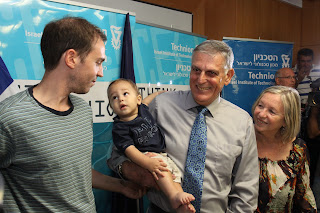
Shechtman with his family after the spontaneous press meeting at Technion (Oct. 5th, 2011).


The Path to the Nobel Prize: Shechtman Timeline.

Meeting at the National Institute of Standards and Technology (NIST) in 1985 just months after shaking the foundations of materials science with publication of his discovery of quasicrystals, Daniel Shechtman, winner of the 2011 Nobel Prize in Chemistry, discusses the material’s surprising atomic structure with collaborators.  From left to right are Shechtman; Frank Biancaniello, NIST; Denis Gratias, National Science Research Center, France;  John Cahn, NIST; Leonid Bendersky, Johns Hopkins University (now at NIST); and Robert Schaefer, NIST.
Seeing is believing, or not?
Technion President Prof. Peretz Lavie with Prof. Dan Shechtman at the
Nobel Prize press conference (October 5th, 2011)


Milestones on the Path to the Nobel Prize

1912
1st Cornerstone of the Technion – Israel Institute of Technology is laid.
1941
Shechtman is born.

1966
Shechtman receives his Bsc from Technion.
1968

Shechtman receives his Msc from Technion.


1972

Shechtman receives his Phd from Technion.


1982

Dan Shechtman discovers Shechtmanite (quasicrystals), observing the icosahedral phase in rapidly solidified aluminum transition metal alloys

1982-84
Shechtman ridiculed, and his paper rejected for publication.
1984
Shechtman’s discovery appears in Physical Review Letters.
1984-1987
Support follows from physicists and mathematicians. Chemist Linus Pauling continues until his death in 1994 to deny Shechtman’s discovery.
1987
Findings presented at Australian crystallography conference and Shechtman finally begins to gain recognition

1988

The International Award for New Materials of the American Physical Society
1990
Rothschild Prize in Engineering
1991
International Union of Crystallography amends its definition of crystals
1993
Weizmann Science Award  
1996
Elected member of the Israel Academy of Sciences
1997
Elected Honorary Member of Materials Research Society of India (MRSI)
1998
Israel Prize in Physics; Honorary Member of ISIS-Symmetry (International Society for Interdisciplinary Sciences); Honorary Member of the Israel Society for Microscopy
1999
Wolf Prize in Physics, “for the experimental discovery of quasicrystals which inspired the exploration of a new fundamental state of matter”; Honorary Member of the Israel Crystallographic Association  
2000
Gregori Aminoff Prize of the Royal Swedish Academy of Sciences; Member of the American National Academy of Engineering; Honorary Member of the French Physical Society
2002
EMET Prize for Science, Art and Culture, “for his pioneering contribution to the discovery of quasicrystals which revolutionized the understanding of solid state science”
2004
Member of the European Academy of Sciences
2006
Honorary Member of the Japan Institute of Metals “in recognition of his outstanding contributions in the field of metallurgy and materials science”
2007
International Symposium: Quasicrystals – The Silver Jubilee, Tel Aviv
2008 
European Materials Research Society 25th Anniversary Award
2011
Symposium to Honor Distinguished Prof. Dan Shechtman on his 70th Birthday, Technion.
2011
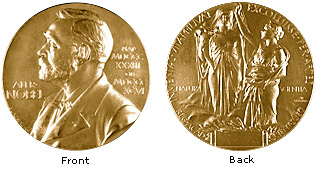
Nobel Prize in Chemistry


“Matter is our World” What is Shechtmanite?


“Matter is our World”
(Nobel Laureate in Chemistry Distinguished Prof. Dan Shechtman).

“Do not consider it proof just because it is written
in books…”
Maimonides (attributed)


“His discovery was extremely controversial. In the course of defending his findings, he was asked to leave his research group… However, his battle eventually forced scientists to reconsider their conception of the very nature of matter… Scientists are currently experimenting with using quasicrystals in different products such as frying pans and diesel engines.”

The Nobel Committee at the Royal Swedish Academy of Sciences

Dan Shectman’s discovery of Shechtmanite (Quasicrystals) on April 8th, 1982 changed our understanding of the material world forever. The breakthrough led to the a plethora of new materials and signalled the end of the scientific belief of condensed phase materials concerning symmetry restrictions. Recognition of the new form of matter required personal stamina, thorough proof and the endurance of ridicule on behalf of the scientist. 


Shechtman was the first to observe the icosahedral phase in rapidly solidified aluminum transition metal alloys, which opened the field of quasiperiodic crystals as an area of study in materials science. This new form of matter – known as quasicrystals, or Shechtmanite – introduces unique and remarkable crystallographic and physical properties, embodying a novel kind of crystalline order. 


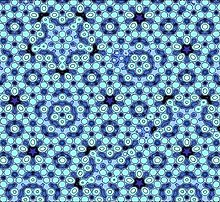
Shechtman’s findings demonstrated a clear diffraction pattern with a fivefold symmetry. The pattern was recorded from an aluminum-manganese (Al-Mn) alloy which had been rapidly cooled after melting. Quasicrystals’ structure can be understood through the mathematical theory of tiling.


At the time, most of his colleagues ridiculed Shechtman’s discovery and his paper with Ilan Blech was rejected for publication. In November 1984, Physical Review Letters published Shechtman’s discovery in a scientific paper co-authored with three other scientists: Ilan Blech (Israel), Denis Gratias (France) and John Cahn (USA). Wider acclaim followed, mainly from physicists and mathematicians, and later from crystallographers. 

In August 1986, David R. Nelson wrote in Scientific American, “Shechtmanite quasicrystals are no mere curiosity. The study of quasicrystals has tied together two existing branches of theory: the theory of metallic glasses and the mathematical theory of aperiodic tilings. In doing so it has brought new and powerful tools to bear on the study of metallic alloys. Questions about long- and short-range icosahedral order should occupy solid-state physicists and materials scientists for some time to come.”

Today, hundreds of materials are known to exist with the structure that Dan Shechtman discovered. Every year, a number of national and international conferences are held on this subject.


Over 40 scientific books have been dedicated to Shechtmanite, or quasiperiodic crystals, and in many other books, the chapters dealing with crystallography have been updated. In wake of the discovery and its proof, the International Society of Crystallographers has changed its basic definition of a crystal, reducing it to the ability to produce a clear-cut diffraction pattern and acknowledging the possibility of the crystallographic order to be either periodic or aperiodic.


The presence of Distinguised Prof. Dan Shechtman at the Technion Department of Materials Engineering, confirms its role as an international powerhouse of scientific research into the wonders of matter..

Prof. Dan Shechtman, Technion Scientist, Wins Nobel Prize in Chemistry

31October 5, 2011 – Distinguished Professor Dan Shechtman of the Technion-Israel Institute of Technology won the Nobel Prize in Chemistry.  Of the five Israeli scientists to have ever won the Nobel Prize, three are Technion professors.
Prof. Shechtman, of the Technion’s Department of Materials Engineering and holder of the Philip Tobias Chair in Materials Science, won the award for his 1982 discovery of Quasicrystals, an entirely new form of matter with a structure that scientists previously thought was impossible.

Israel’s President Shimon Peres called Prof. Shechtman to congratulate him: “I salute you, you gave the people of Israel a wonderful gift. This is a great day for Haifa, a great day for the Technion.”

“That an Israeli has once again been awarded a Nobel Prize is a mark of distinction for Israeli science in general and for the Technion,” said Technion President Peretz Lavie.  “And the fact that this is the third Nobel Prize in Chemistry for Technion researchers in eight years is a clear indicator of the world-class research being done here.”

The Royal Swedish Academy of Sciences said Shechtman’s discovery fundamentally changed the way chemists look at solid matter. It initially faced strong objections from the scientific community.

Since then, Quasicrystals have been produced in laboratories and a Swedish company found them in one of the most durable kinds of steel, which is now used in products such as razor blades and thin needles made specifically for eye surgery, the Nobel citation said.

Scientists are also experimenting with using Quasicrystals in coatings for frying pans, heat insulation in engines, and in light emitting diodes (LEDs).

On April 8, 1982, when Shechtman first observed crystals with a 10-point pentagonal symmetry in the NBS laboratory in Maryland, crystallography had long been considered a “closed field” promising no revolutionary breakthroughs. Shechtman’s groundbreaking quasiperiodic structure was first described in Physical Review Letters in 1984, marking the birth of a new scientific field of Quasiperiodic crystals.

The scientific community, led by two-time Nobel laureate Linus Pauling, rejected Shechtman’s findings, but in 1987, the pattern which had previously been considered contrary to the laws of nature was observed with the help of the electron microscope.

More than 40 scientific books have been dedicated to Quasiperiodic crystals, and hundreds of materials are known to exist with the structure discovered by Shechtman.  In the wake of his discovery and its proof, the International Society of Crystallographers changed its basic definition of a crystal.

Prof. Shechtman’s Nobel Prize follows many other prestigious awards including the Aminoff Prize from the Royal Swedish Academy of Sciences (2000), Wolf Foundation Prize in Physics (1999), Israel Prize in Physics (1998), Weizmann Prize in Science (1993),  Rothschild Prize in Engineering (1990) and the International Award for New Materials of the American Physical Society (1987).  He is a member of the Israel Academy of Sciences and the U.S. National Academy of Engineering.

Above: Distinguished Professor Dan Shechtman

Technion team wins first place in the European entrepreneurship competition “Intel Challenge”

30Receive $20,000 & go on to the finals to be held in November in the U.S.
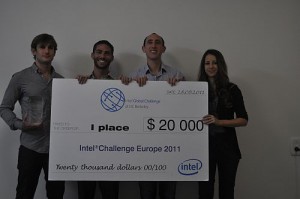
A team from the Technion won first place in the European entrepreneurship competition “Intel Challenge” and will participate in the finals of the world championship to be held in November in the U.S. The group reached the final round in the “BizTECH” competition held a few months ago in Israel with their venture that allows, as they put it, anyone taking a picture “to get a perfect photograph by pressing one button, without having to be an expert in photography and without needing to take the picture more than once.”

Yaron Ratcher, Polina Federman, Avner Bar and Aviv Gadot are the members of the Technion team. Yaron is a computer science major, Aviv is an electrical engineering major, Avner graduated with a degree in computer science and Polina graduated from the Faculty of Industrial Engineering and Management. The idea for their venture emerged from the entrepreneurship course given by Prof. Uzi De-Haan of the Faculty of Industrial Engineering and Management at the Technion.

 “In the BizTECH competition, we weren’t quite so ready,” they say. “We were disappointed when we didn’t win but we kept going. We learned a lot from the competition, we corrected the mistakes we saw we’d made and kept going.”

180 teams from Western and Eastern Europe participated in the competition, which was held in Poland. Nine of these teams made it into the final round. The Technion team was included among the four finalists from Eastern Europe. The first place among the Western European teams was won by two young women from Denmark who applied for a patent for their development of an ozone-based sunscreen.

The Technion team immediately invested the $20,000 they won in their venture and hope that this is only the beginning.

In the picture (from right to left): Polina Federman, Avner Bar, Yaron Ratcher, Aviv Gado. Photo by: Technion Spokesman

At the Road Safety Conference held at the Technion: The police complete their “Spring Spirit” experiment

The experiment proved that Covert enforcement is the most effective method & preferred also by the police

The motorcycle unit also proved its worth & it will, therefore, more than double in size: from 45 heavy motorcycles to 100

The undercover enforcement method is the most effective and policemen and women also prefer it, so it appears from an experiment run by the Research, Information and Development Bureau of the Traffic Division of the Israel Police.

The results of the experiment, “Spring Spirit” as it was called, were presented today at a conference held in the Faculty of Civil and Environmental Engineering at the Technion, on the subject of: Current research in the area of traffic safety and implementation in Israel. Chief Superintendent Iran Feinmessar, head of the bureau, said that the experiment ran for five months and ended at the end of July this year. The experiment tested different operational methods used by the national traffic police and was run in different police districts around the country. It included, among others, switching overt police units with covert ones and increasing the motorcycle units as well as helicopters. The Tel Aviv, Jerusalem and Arava districts were used as control groups and no changes were made there.

The main conclusion of the experiment – covert enforcement is the most efficient. Additionally, the heavy motorcycle unit proved its worth and will, therefore, be more than doubled – from 45 motorcycles to 100. Chief Superintendent Feinmessar reported that the police have also begun operating undercover heavy motorcycle teams. “It will be interesting to see drivers’ reactions when they realize that the motorcycle riding alongside them is not what they thought it was,” he said.

Another experiment that the Research Bureau ran was in stationing volunteers in reflective vests at dangerous intersections. The volunteers just stood at the intersections, did not hand out fines or make comments to pedestrians or drivers that crossed the intersection. The result of their standing in the intersection wearing the reflective vest – a decrease in the number of cars that crossed the intersection on a red light down to zero and a drop to half in the number of pedestrians who crossed the street when the light was red.

The conference was organized by the National Road Safety Authority, the Transportation Research Institute and the Ran Naor Center for Road Safety Research at the Technion, headed by Prof. Shlomo Bechor.

Three submissions win at the Technion’s Energy Conservation Competition

29 Generating energy by working out at the gym, checking real-time energy consumption & exploiting Technion’s position on the slopes of the Carmel

Green dynamo – exploiting the potential difference in water flow;

Energy screen – displaying data about energy conservation;

Fitness club – exploiting energy generated by working out.

These are the three submissions that won the first-of-its-kind competition held at the Technion on the subject of energy conservation. Tens of proposals were submitted to the panel of judges headed by Technion President, Prof. Peretz Lavie, and comprising Technion researchers and representatives of the Israel Electric Company. Of the 13 submissions that made it to the final round, three won.

Green dynamo – The submission by student Philip Auchman, of the Faculty of Mechanical Engineering, won first prize. He proposed exploiting the Technion’s surplus water pressure, which is high thanks to the Technion’s position on the slopes of the Carmel Mountain. “By using a simple device, a type of turbine that penetrates the pipe and rotates a dynamo, we can create energy,” he explains. “Because of the steep slope on which the Technion is situated, wide use is made of pressure reducers, and in my opinion, we can exploit this pressure to generate energy.”
Noam Berkovitz, from the Technion’s Computerization and Information Systems Division, won second place with his proposal to place “energy screens” around the campus. These screens would display information about the real-time energy use in each building and even warn about energy over-consumption.

Doron Laor, a student in the Faculty of Mechanical Engineering, won third place. He proposed using the energy produced by users of the Technion’s fitness club to generate energy. “People in the fitness club burn calories and we can exploit their activities to generate energy,” he says. “For example, all the runners or walkers on the different apparatuses can generate energy by their activity, which can operate the air conditioners.”

Itzik Romano, the Technion’s electrical engineer, said that ten divisions in the institute had managed, over the past four years, to save over five million shekels worth of energy and additional faculties are set to join the Technion project to save energy. “The competition that we held is one more step in our efforts to save energy and increase awareness about saving,” he emphasizes.

The competition was held in cooperation with Tal Goldrath and the Technion’s “Green Campus” team, the Samuel Neaman Institute, and the Israel Electric Company.

Executive Vice President and Director General of the Technion, Dr. Avital Stein, who awarded the prizes to the three winners, said that not for nothing is the Technion known worldwide for the creativity of its students and graduates, and the winning submissions are further proof of this.

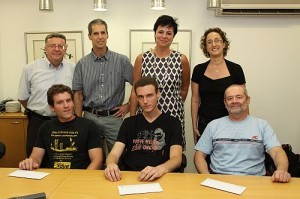
Above: The three winners (sitting, right to left): Noam Berkovitz, Philip Auchman, and Doron Laor. Standing (right to left): Tal Goldrath (coordinator of the “Green Campus”), Dr. Avital Stein, Itzik Romano, and Beni Cohen, head of the Department for Energy Efficiency in the Israel Electric Company. Photo by: Yoav Bechar, Technion Spokesman.

Views: What Global Rankings Ignore – Inside Higher Ed

Views: What Global Rankings Ignore – Inside Higher Ed

Consider Israel. According to data on NASDAQ’s website, Israel has more companies listed on the NASDAQ stock exchange than any other country in the world except the U.S., and major companies such as Intel, Microsoft, IBM and Google have major research and development centers in Israel. Why? If you look at the data, you see a correlation between this entrepreneurial activity and the investments in and outputs from Israel’s universities.

Israel is among a handful of nations with the highest public expenditure on educational institutions relative to GDP, and it has the highest rate of R&D investment relative to GDP in the world. It also has the highest percentage of engineers in the work force and among the highest ratio of university degrees per capita. Many of the companies listed on NASDAQ were started by graduates of Israel’s universities: Technion, Tel Aviv University, Weizmann Institute and Hebrew University of Jerusalem, to mention a few. Do international university rankings capture these economic impacts from research and postsecondary education in Israel? The answer is no. In spite of their tremendous impact and output, Israel’s universities are ranked somewhere in the 100 to 200 range.

Check out the full Opinion piece!

Photovoltaics & the Power of Tomorrow

Dr. Guy Ankonia at the Joint GTEP & RBNI Photovoltaic Laboratory

Our collective will to power
Formed through an alliance of Technion’s most dynamic multidisciplinary programs, the PV lab is helping scientists unleash the power of the sun to generate tomorrow’s much-needed energy.


This is not a solar luxury to save cash on fuel bills. Global scientific experts agree that with depleting oil reserves and astronomical increases in world population, the quest for new energy sources is vital to keep our world safe, and that solar power is in first place as the energy supplier of the future.

Photovoltaic cells are used in solar panels across Israel to heat water. However, scientific investigation is still needed to optimize the use of different types of silicon within the cells, for mass production of electricity. Bringing energy know-how and expertise in the nano dimension together, the Grand Technion Energy Program (GTEP) and the Russell Berrie Institute of Nanotechnology (RBNI) are combining strengths in the new photovoltaic initiative. The lab gives Israeli researchers from industry and academia the basic and advanced tools for the fabrication and characterization of photovoltaic devices. 

“Here, there is the freedom to explore what you think is right – in order to gain knowledge,” says lab manager Dr. Guy Ankonia. “Scientists can explore all frontiers of PV… what was not known becomes known. Technion is a great place to do the research. You have the tools, the capabilities to explore, and the freedom.”


Attention PV Researchers from Industry and Academia!
The Following facilities are available:

  • Solar simulator
  • CIMPS/CIMVS
  • Quantum Efficiency
  • Ellipsometer
  • MVD

Read and subscribe to the latest edition of Technion Live.

Technion Maglev

Technion Autonomous Systems Program (TASP)
Technion student ingenuity wins 1st prize for Maglev car.

“Studying at the Technion has made me realize I can learn and create almost anything.”

Alert to future need: graduate student in civil engineering Erez Horev.

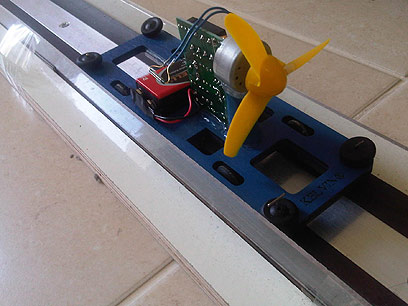
Cars that use magnets to hover through the air could sound like science fiction, or the fantasy of children. But since the success of high-speed Maglev (Magnetic levitaton) trains in Japan, there is reason to dream. Having worked in Israel’s transport system, Technion student Erez Horev is determined to explore the science that could make Maglev transport part of Israel’s future – dramatically saving energy and reducing environmental damage.
Although he is a graduate student in civil engineering, Erez Horev heard of the competition at the Technion Autonomous Systems Program and seized the moment. For months in his spare time he had been working on his Maglev car, and although his supervisor saw it as “too futuristic” for a full-time research project, Horev (like his name-sake former Technion President and global leader in engineering Amos Horev), he doesn’t give up.
The first prize, won together with another project in which a toolbox follows it’s owner around, won the attention of Israel’s national media. The idea first came to Horev when he was working on Israel’s new fast pay-road Highway 6, and later on the new light rail project in Haifa. The car operates normally but has six magnets attached to underside. When it enters the magnetic highway, the system is activated. “With this system, you could live in Italy and work n Germany and commute the whole distance in 50 minutes,” says Horev. “The car will go at 400 mph and the driver can go to sleep.”
In ordinary vehicles, 99% of the energy is used to overcome the friction between the wheels and the road. In the Maglev car, the friction is so minimal that it would lead to enormous savings in fuel. The system  simulates a magnetic toll road for private vehicles. “Because of the high speeds that can reach them using this technology, the project could compete not only with existing toll roads, but even with domestic flights and trains,” says Horev.
Prize-winning Maglev car prototype “floats” above road surface at high speed.
“At the Technion, studies are always multidisciplinary. Although I study civil engineering, we also delve into physics, mathematics, organic chemistry. Studying at the Technion has made me realize I can learn and create almost anything.”
One can’t help think about Technion graduate Shai Agassi who presently launching his exemplary electric car system and infrastructure in Israel through his global company Better Place. A man who dares to dream and has the practical penchant for problem-solving and determination to see a project through, Horev admits that Agassi is in himself a template for Technion students.
“Every day is a new day,” he smiles, “Today, there is little research in the field of maglev. It is seen as too futuristic. But I will go on implementing the idea in my space time. I want to address a huge demand for governments and companies to invest in research and development of new transportation methods and efficiency, since citizens are tired of spending more than two hours in endless traffic jams. This issue is close to my heart, and I’m going to go with it to the end.”
To enhance their research, the Technion established the Technion Autonomous Systems Program(TASP), the only one of its kind in Israel, and the scientific home for dozens of advanced researchers from many faculties.  


World’s longest Yo-Yo

The Technion “Technobrain” Competition Opens 
The world’s longest yo-yo will be released from a 30 m high crane

As part of Technion’s traditional “Technbrain” competition, students will compete against each other by releasing the world’s longest yo-yo from a 30 meter high crane. The yo-yo will have to run back up a 20 meter long rope, to its maximum height and then drop down again and run up a number of times to a minimum of over 5 meters. A team of judges will measure the maximum height the yo-yo reaches on its first ascent after release from the crane and the number of times it loops up and down.
The crane will have a compartment in which the yo-yo will be placed. The compartment’s floor will open and the yo-yo will be released downward. Competitors are not allowed to use an external energy source and the dynamic rope will be supplied to them by the competition organizers. Winners will receive 10,000 ₪, 5,000 ₪, and 3,000 ₪ (1st, 2nd and 3rd places, respectively).
The “Technbrain” competition is held at the Technion in memory of Neev-Ya Durban, who first envisioned and thereafter established the competition, and was a student and outstanding Technion graduate. Neev-Ya was an officer in the IDF when he was murdered during a mugging on a quiet street in Tel Aviv in March 2003. The competition and the prizes are funded by Dr. Robert Shillman (who everyone knows as “Dr. Bob”), who did his graduate work at the Technion.

Technion Book of Faces

A Technion Book of Faces

In 2012, Technion celebrates 100 years since the laying of its 1st cornerstone.
This century has seen many miracles – the miraculous birth of Israel as a nation; the awesome transformation of our world into a global village where technology and science bring the keys to the future of health, communication, the environment, energy, security and global communion.
From 1912, until today, Technion – Israel Institute of Technology, has been part of this miracle.
Within every nation, there are citizens that have lived the story of its suffering and its success. Behind every scientific and high-tech innovation there is a scientist with a story. Within the mind of each scientist there are sparks of curiosity and inspiration – the inspiration behind the Start-up Nation.
Here are just some of the living stories of innovation, human integrity and achievement from Technion ~ Israel Institute of Technology.

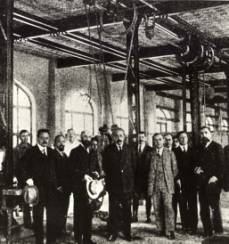
Technion founding father Prof. Albert Einstein at Technion.

The Brainstormer
“What is important are the many e-mails I receive from grateful patients helped by Rasagiline.” Prof. Moussa Youdim

It was his father’s struggle with deep depression over business troubles in 1957 that changed the course of Prof. Moussa Youdim’s life, from studying medicine to going into pharmacology. He sought a more refined, and merciful understanding of brain chemistry that would help bring treatment and relief to millions.
Prof. Youdim is today internationally renowned for his brain research and drug development in depressive illness and Parkinson’s and Alzheimer’s diseases. He has established the importance of monoamine oxidase and brain iron metabolism for brain function that can lead to cognitive impairments and neurodegenerative diseases.


Where internet began.

“They unequivocally bear the stamp of the present century.” BBVA Foundation President, Francisco Gonzále, at the Frontiers of Knowledge Awards, 2009.

The Lempel-Ziv algorithm – the mathematical formula for compressing vast amounts of information – is the thought power that enabled the high-tech communications revolution of our generation.
From the birth of the internet, through to the global broadcasting of live images from Mars, we are indebted to the science behind compression and decompression made possible by the legendary Technion algorithm in 1983.
Tiberius-born Prof. Jacob Ziv and Poland-born Prof. Abraham Lempel changed the direction of mankind by bringing the best compression ratio ever. This became the standard utility in unix systems, the gif image format, tiff, pdf and adobe acrobat software.
Generations of Technion graduates mentored by the two pioneering professors, adopted not only the knowledge, but also the spirit of innovation, empowering the high-tech revolution, in Israel and across the globe.


Light Man 2020

“Technion is the place I chose to do this research.” Distinguished Prof. Moti Segev

What is light? How is it composed? How to unravel the secrets of a soliton – a single wave packet of light? What wonders of technology and science can be achieved when we master its power?
Distinguished Prof.Mordechai (Moti) Segev was raised in Haifa to a poor immigrant family of shoemakers. But little Moti had a secret – the secret of what happens when you excel beyond all frontiers.
Years later – as the first Israeli to be offered a tenured position in Princeton in 1998 – Segev chose to return to Technion and to create there a focus of optics research alluring excellent students and faculty from across the world. Some proofs of his global success include  the world’s first observation of 2D lattice solitons, and the first experimental demonstration of Anderson localization in a disordered periodic system.


A Matter of Class

“If you believe in your research then fight for it. Fight for the truth.” Distinguished Prof. Dan Shechtman.

Since 1912, matter – the miracle of everything in our world – was defined by scientists with a strict paradigm: crystals are ordered and periodic  – with no exception. That was before Israeli-born Distinguished Prof. Dan Shechtman reached for the electron microsope in 1982 – the year humanity’s perception of matter was changed forever.
Shechtman broke all the rules when he revealed a new class of matter – “Shechtmanite” – crystals with 5-fold rotation symmetry. “I was alone. I was ridiculed by my colleagues and my peers,” tells Shechtman, who stood by his revolutionary research into quasi-periodic crystals despite the disgrace it brought him among international scientists.
The new strength of material made available through quasi-periodic crystals has today converted the world,  opening a range of applications in super-strong steel – especially where it contacts the human body, such as in surgical equipment.


Multi-tasking Stem Cells

“Everyone knows about the Technion…”Prof. Shulamit Levenberg

One of seven sisters in a religious family, no-one could foresee that Prof. Shulamit Levenberg would change the course of global science. Yet, when she revealed a breakthrough process to create living human tissue in the lab – she opened a new dimension of promise in medical research – that could eventually culminate in a medical ability to cultivate and replace damaged organs in the body.

Prof. Levenberg conducts interdisciplinary research in the subjects of tissue engineering from human embryonic stem cells using biodegradable polymers. She is recognized as a world leader in the field. Her research proved that it is possible to create complex muscle tissue including blood vessels (as well as beating heart muscle) in a laboratory. She has been named among the world’s top 50 science leaders by the prestigious magazine Scientific American.

The Imagineer

“Technion is a holistic experience.” Technion Alum Shai Agassi

Proud Technion alum Shai Agassi wants to put you behind the wheel of an electric car — but he doesn’t want you to sacrifice convenience (or cash) to do it.
When horrific climate-change scenarios elicit little but endless chatter from governments and entrenched special interests, the difference between talk and action represent an embarrassing gulf. Meet exemplary Technion alum Shai Agassi, who has stepped fearlessly into that gap. His approach to solving the puzzle of electric automobiles could spark nothing short of an automotive revolution.
Agassi stunned the software industry in 2007 by resigning from SAP to focus on his vision for breaking the world’s fossil-fuel habit, through his global start-up Project Better Place. Recently he signed up to make San Francisco the EV capital of the US – with a revolutionary switchable battery electric taxi program.


The Kiss of Life

“Mentorship is as important as science.” Nobel Laureate Avram Hershko

Ubiquitin: so called, because it is a protein present in all living cells. No-one knew why it was there, and no-one dared to wonder: it was just boring – “ubiquitous”.
But no living secrets are untouched by Technion scientists. Throughout the ‘70s and ‘80s, Distinguished Professors Avram Hershko and Aaron Ciechanover unveiled the mysteries of  the ubiquitin system, revealing the masterkeys of human health. The ubiquitous protein ubiquitin, they showed, is the key factor in deciding when and how a cell should regenerate. Imbalance in ubiquitin reveals itself in some of the world’s most incurable afflictions – such as cancer and neuro-degenerative disorders.
By 2004, the Technion research was already revolutionizing medical understanding and opening the way to innovative cures and treatments. No wonder that, in that year, the two Technion Professors became Israel’s first Nobel Laureates in science.


Sniffing Out Cancer

“I am where I feel that I contribute the most.” Dr. Hossam Haick

When Dr. Hossam Haick was studying for his doctorate, a friend of his was diagnosed with leukemia. “It was very painful for me. I saw his suffering. That was the first time I began to think about diagnosing cancer by means of oxygenating substances that are excreted in a photocatalytic procedure (accelerated by light ) and come into contact with cancer cells. Nazareth-born Haick has since amazed the world with an ingenious system for detecting cancer via breath tests.
Haick’s patented “electronic nose” promises to detect several types of cancer in their early stages. His goal is to detect cancer early enough  to give the human body a better chance of beating the disease.


9/11 Never again

“At critical moments in an emergency, there is no time.” Security expert Prof. Avi Kirschenbaum.

A decate later and the trauma is fresh. And the global threat is still there. Post 9/11, everyone wants to know they are safe on a plane.  
High-tech security innovation has always been quietly high on the scientific agenda of Israel’s top institute of technology, but recently world headlines showed another aspect of Technion expertise – people management in a crisis.
“At critical moments in an emergency, there is no time to consult a supervisor or read the manual,” says Prof. Avi Kirschenbaum, whose decades of expertise in home-front security recently won his team a $5 million grant by the European Union to ensure airport against hostile threats. “In order to prevent disasters and deal with them properly, we have to ensure that all the teams, and not just security teams, will be trained and highly motivated.”


Upwardly Motile

“For interdisciplinary science, Technion is an excellent place.”  Prof. Kinneret Keren

Named one of the 100 top young innovators by MIT’s Technology Review Magazine, Dr. Kinneret Keren is researching nature’s genius in self-assembly. On one hand this can be used  in the creation of nano-scale electronics; on the other, it brings a  wealth of understanding to  medical science – understanding  a cell’s motility – or how it  moves through space and time can provide the master-keys for healing such diseases as cancer or heart disease.
Keren integrates physics and cell biology in her research, moving between real and artificial cells. “The biophysical aspects of cell biology have been neglected in many areas,” she explains: “Basic cellular processes are highly relevant to understanding normal processes and diseases, for example, understanding how and why cells move faster brings a chance to better understand how cancer spreads.”


Think Global
Think Technion

“Israel can win the battle for survival only by developing expert knowledge in technology.”
Prof. Albert Einstein (President of the first Technion Society)
“Technion has a great contribution to make to Israel’s future prosperity, and Israel’s prosperity cannot but be of great benefit to other countries, as well.”
Winston Churchill (The late Prime Minister of Great Britain)
“You – the people of the Technion – have led the way in technology, science and engineering.”
Yitzhak Rabin (The late Prime Minister of Israel)
“The Technion has been a beacon of learning in our region.”
The late King Hussein of Jordan

And no-one should ignore the most amazing part of Technion….

THE STUDENTS!