

"The pain is one - The pain of lives cut short in an instant"
From a speech by Technion President Prof. Uri Sivan at the Memorial Day ceremony held at the Fallen Soldiers Memorial Plaza at the Technion.
Bereaved families, members of the Technion community, and distinguished guests.
The week that begins with Holocaust Remembrance Day and ends with Memorial Day is the saddest and most difficult in the Israeli calendar. These are harrowing days of sorrow, pain, remembrance, and soul-searching, culminating in the siren that marks the transition from Memorial Day to Independence Day. I did not have the privilege of knowing my grandmothers, who perished along with many members of my family in Treblinka and Auschwitz, or my grandfather, who perished in the Warsaw Ghetto. During my military service and afterwards, I lost many friends,: Harel Alterman who was like a brother to me, Ilan Kaufman, and Moshe Wittner, whose names are engraved on the wall behind me. For me, a direct line, and the cry Never again—connect them.
This is true every year, and even more so over the past two and a half years: the wounds of October 7 and the Swords of Iron War are still open and bleeding. Thousands of casualties, hundreds wounded, and more than forty killed, half of them civilians, in Operation Roaring Lion alone. The pain continues and accumulates into a suffocating burden.
The Hebrew language distinguishes between those who fall in battle, those murdered in acts of terror, and those killed in wartime attacks against civilians, but the pain is one: the pain of lives cut short in an instant, and of family members and friends whose lives have been changed forever. This is the price of life in this country, and we are all on the front line.
On October 7 and in the war that followed, the Technion family lost 14 students and alumni: Yoram Bar Sinai, Hagit Rafaeli-Mishkin, Yaakov Nedlin, Eliran Yeger, Dov Kogan, Denis Krokhmalov-Veksler, Alon Safrai, Amit Chayut, Shmuel Harari, Evgeny Zinershtein, Moshiko (Maxim) Rozenwald, Ofer Yung, Dima Gershovich, and Barak Kalfon, who fell this past weekend. Many among us have lost family members and friends who walk beside us day after day, in times of joy and of sorrow.
I extend the condolences of the entire Technion family to the Chayut and Ram families, who are with us here today, and to all the families who have lost what was most precious to them.
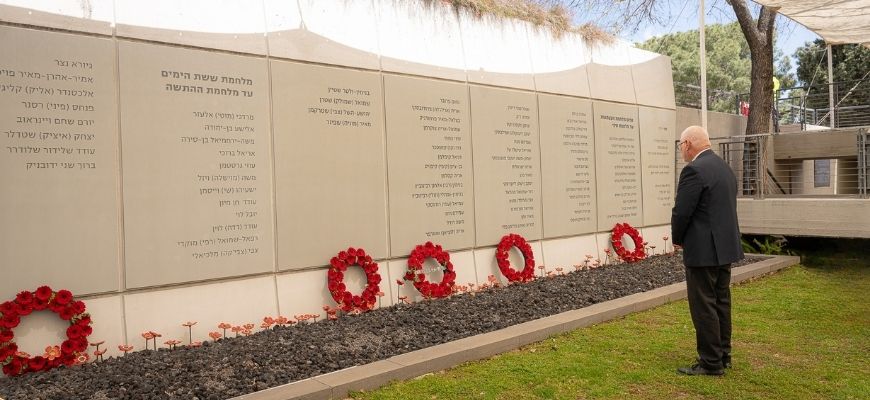
Since its erection, 194 names of Technion faculty members and students who fell in Israel’s wars and in acts of terror have been engraved on the memorial wall behind me. The Fallen Soldiers Memorial, standing at the heart of the campus, symbolizes the sad, difficult, and heavy core that we carry with us always. Every name on that wall is an entire world: lives cut short, dreams, loves, plans, and bright futures. Our hearts shatter into pieces anew each time. The names are engraved there to remind us, every day and every hour, of those who in their death commanded us to live, and of their families and friends who paid the heaviest price of all.
Our alumni who had already completed their studies have been commemorated in distinct other ways. Technion graduates—some one hundred thousand women and men—have had an unparalleled impact on the State of Israel and helped shape its path. Every day and every hour, they carry the mission and contribution to the State of Israel on their shoulders, whether through active reserve duty, safeguarding the country’s security, developing means of defense, or advancing the economy and society. They constitute a broad civilian community, drawn from every part of Israeli society, that stands ready and answers the call whenever needed.
Today, I would like to remember four of our dear alumni. Four of our own, who were killed over the past two and a half years: Ofer Yung, Evgeny Zinershain, Dima Gershovich, and Barak Kalfon.
Warrant Officer (res.) Barak Kalfon, of blessed memory, who fell last Friday in southern Lebanon, grew up in the Krayot and lived in the community of Adi. He completed a bachelor’s degree in the Faculty of Mechanical Engineering and a master’s degree in systems engineering. Barak played alongside his brother on the Technion water polo team. For many years, he worked at Rafael, a vital company, daily engaged in defending the State of Israel and its citizens. And as if this contribution were not enough, he volunteered for reserve duty as a paratrooper. At the age of 48, he could long ago have been released from reserve service, but he kept telling his family, “There’s no one else to do reserve duty,” and every time he was called up, he reported for duty again. Barak was killed after the ceasefire had been declared, by an explosive device when he entered a booby-trapped building together with his company commander. He is survived by his wife and two daughters, his parents, and his siblings. May his memory be blessed.
Ofer Yung, of blessed memory, a Master Sergeant in the reserves, grew up in Haifa and was a devoted fan of the Maccabi Haifa soccer team. “A scientist from birth,” his relatives recall. He was an outstanding student, competed as a judoka in the Maccabiah Games, and after high school enlisted in a combat track in the Kfir Brigade. After completing a squad commander’s course, he served as a commander in the brigade. After completing his studies in the Faculty of Civil and Environmental Engineering at the Technion, he established an independent green construction business and became one of the best-known experts in the field. On October 7, Ofer did not wait for a call-up order. He left home and from then on served hundreds of days of reserve duty, some of them after the birth of his son, Eitan. “There is no choice,” he told his wife Dana, “we are fighting for our home.” Ofer fell in the war for our home in northern Samaria in February 2025, when he charged a terrorist who had ambushed his unit. Through his swift response, resourcefulness, and bravery, he prevented an even greater disaster. May his memory be blessed.
Evgeny Zinershain, of blessed memory, a Major in the reserves, was born in Khmelnytskyi, Ukraine, and immigrated to Israel with his mother at the age of 14. Despite being an only child and therefore eligible for exemption from combat service, he volunteered for the Paratroopers Brigade and rose from soldier to commander. He completed his degree in the Henry and Marilyn Taub Faculty of Computer Science with distinction and then went on to pursue a master’s degree at Bar-Ilan University. Evgeny and his wife, Sasha, had two sons and a daughter, and they often took them on trips in Israel and abroad. During his reserve service, Evgeny held a series of command positions until he was appointed commander of the support company in his battalion. Like many of his peers, he was called up on October 7 and served hundreds of days in the reserves. He was killed in December 2024 during ground-clearing operations in southern Lebanon. Varonis, the company where he worked, established an internship and scholarship program in his memory for students serving in the reserves. May his memory be blessed.
No defense system—ground or aerial, however advanced and sophisticated—can provide absolute protection. And despite the enormous investment and the inspiring technological progress, dozens of civilians have been killed in recent months in missile attacks from Iran, Lebanon, and the Gaza Strip. One of them was Technion alumnus Dima Gershovich.
Dima was killed three weeks ago by an Iranian missile strike, together with his wife Lucille-Jane and his parents Vladimir and Lena. His father, Vladimir, had worked for several years at the Technion, and his mother, Lena, was a legendary voice teacher at the Nissan Nativ School. Dima, a gifted child who mastered 11 languages, immigrated to Israel with his parents at the age of seven, completed high school, and was admitted as an Atuda student to the Henry and Marilyn Taub Faculty of Computer Science. He served as an officer in the Intelligence Corps, and after his military service, entered the high-tech world. Until his tragic death, he worked at the Israeli software company JFrog. May the memory of the dear Gershovich family be blessed.
Together with the rest of the citizens of the State of Israel and the Jewish people in the Diaspora, we are experiencing one of the most difficult and painful periods in the history of the Jewish people, perhaps the most difficult since the end of the War of Independence. But the pain and bereavement will not weaken our resolve, and we are determined to continue fulfilling our mission in teaching, research, and strengthening the resilience of the State of Israel.
One hundred and one years of history provide perspective. Throughout all those years, the Technion has never ceased its activity. Not during World War II, not during the War of Independence, and not during the Yom Kippur War. Even now, in the face of barrages of missiles and rockets, we did not consider even for a moment the possibility of closing our campuses in Neve Sha’anan and Bat Galim.
The Technion has played a historic role in strengthening the security of the State of Israel. Iron Dome, the Arrow missile, David’s Sling, and similar developments led by Technion alumni have saved many lives over the past two and a half years and enabled the State of Israel to continue functioning.
We have always acted out of a sense of national mission, centered on responsibility for the country’s security, economy, and society. We instill this sense of mission and our values: social responsibility, moderation, tolerance, acceptance of others, and the pursuit of truth, in our graduates as well. This is our steadfast and determined answer to all threats and challenges. Our compass is clear, and we will not be diverted from our path.
And on this painful day, on the eve of Memorial Day, we once again pledge to the members of the Technion family whose names are engraved here and in our hearts, to the families of the fallen and their friends, and to the wounded and their families, to continue doing everything in our power to be worthy of their sacrifice. Our annual gathering here, before the memorial wall, is a special opportunity for us as a community and as a society to remind ourselves how heavy the price of life here is, to embrace the families of the fallen and the murdered, and to promise them that we will not forget their sacrifice. This is our opportunity to honor the memory of the fallen and to renew, year after year, our vow to give ever greater meaning to that sacrifice. If we succeed in doing so, we will know that we have fulfilled their legacy.
May their memory be blessed.