


Technion Researchers Receive Prestigious IEEE Award for Breakthrough in Omnidirectional Control of Electromagnetic Waves
A paper by Technion researchers has received the prestigious R.W.P. King Award from the IEEE Antennas and Propagation Society (AP-S), part of the Institute of Electrical and Electronics Engineers (IEEE), the world’s largest professional organization for electrical and electronics engineers. The R.W.P. King Award recognizes the best paper by an author under the age of 36 published in its flagship journal during the previous year.
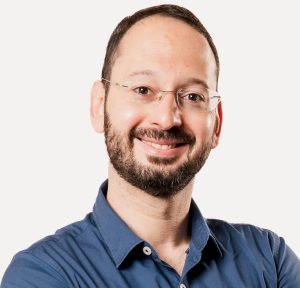
The award-winning paper was authored by Prof. Ariel Epstein of the Andrew and Erna Viterbi Faculty of Electrical and Computer Engineering and Dr. Amit Shaham, who recently completed his Ph.D. under Prof. Epstein’s supervision and is now a postdoctoral researcher at the Advanced Science Research Center (ASRC) of the City University of New York (CUNY).
Published in IEEE Transactions on Antennas and Propagation in August 2025, the paper introduces a pioneering method for advanced control of electromagnetic-wave propagation via reflection and transmission through engineered artificial surfaces (metasurfaces). Demonstrating judicious design of these ultra-thin composites, the researchers succeeded in shaping their wave scattering across a wide range of incidence angles with far greater flexibility and efficiency than existing approaches.
The research is unique in the sense that it provides a universal framework for precisely defining the electromagnetic properties required to achieve ideal omnidirectional responses and translating them directly into simple, readily manufacturable structures. This technology enables a broad spectrum of applications, ranging from low-profile electromagnetically transparent antenna covers (radomes) to artificial mirrors that behave as ideal magnetic conductors.

The work has significant practical implications for advanced electromagnetic and photonic technologies, where compact, low-cost devices facilitating effective high-resolution imaging and wide-angle control of waves are in high demand. Potential applications include next-generation cellular and satellite communication systems, smart antennas, radars, LiDARs, and optical analog image processing components.
The award is named in honor of Prof. Ronold W. P. King, one of the pioneers of antenna theory and electromagnetics in the twentieth century and a longtime professor at Harvard University.
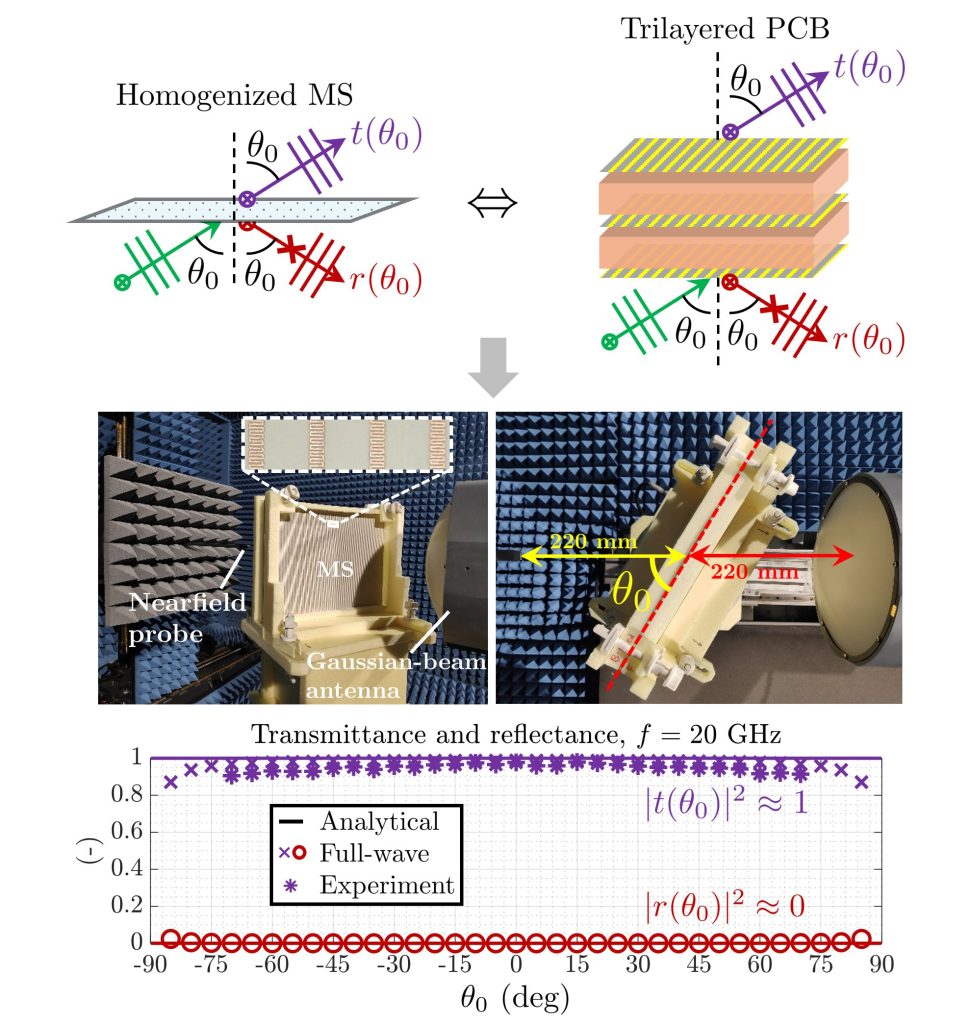
Figure caption: The paper’s key innovation: a rigorous mathematical framework demonstrating how angle-dependent scattering of electromagnetic waves, defined by the abstract properties of a theoretical metasurface (top left), can be realized using a standard three-layer printed circuit board (right). This implementation fully preserves the desired theoretical reflection and transmission characteristics over the entire range of incident angles within a highly practical platform for a wide variety of applications. In the main demonstration, the researchers realized a mechanically rigid surface that remains completely transparent to electromagnetic waves from every direction – a capability required for advanced antenna and LiDAR applications. The middle image shows the fabricated prototype undergoing characterization in the Technion’s Modern Electromagnetic Theory and Applications (META) Laboratory. The bottom image presents simulation and experimental results across a broad range of incidence angles, demonstrating full transmission (purple) and zero reflection (red), as designed
To IEEE announcement:
https://ieeeaps.org/ieee-tap/news-tap/ieee-tap-news/tap-2026-king-award-announced


