

The slow ones are the fastest: a new microfluidic method for microscale bio separations
In a recent paper published in Angewandte Chemie and designated by the journal as a “Very Important Paper,” researchers at IBM Research Europe in Zurich and at the Technion – Israel Institute of Technology presented a new method and device for separation of particles and biomolecules.

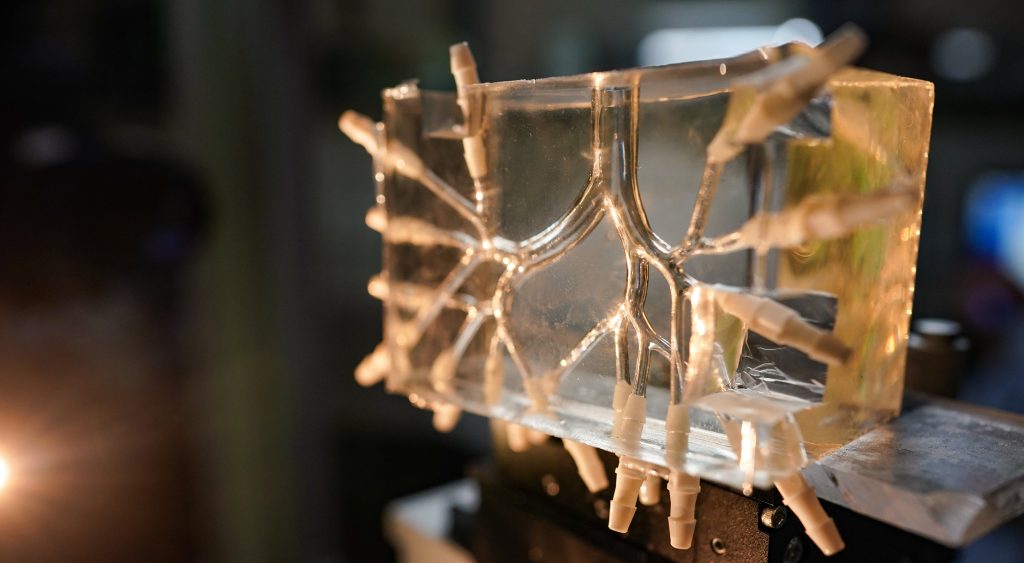
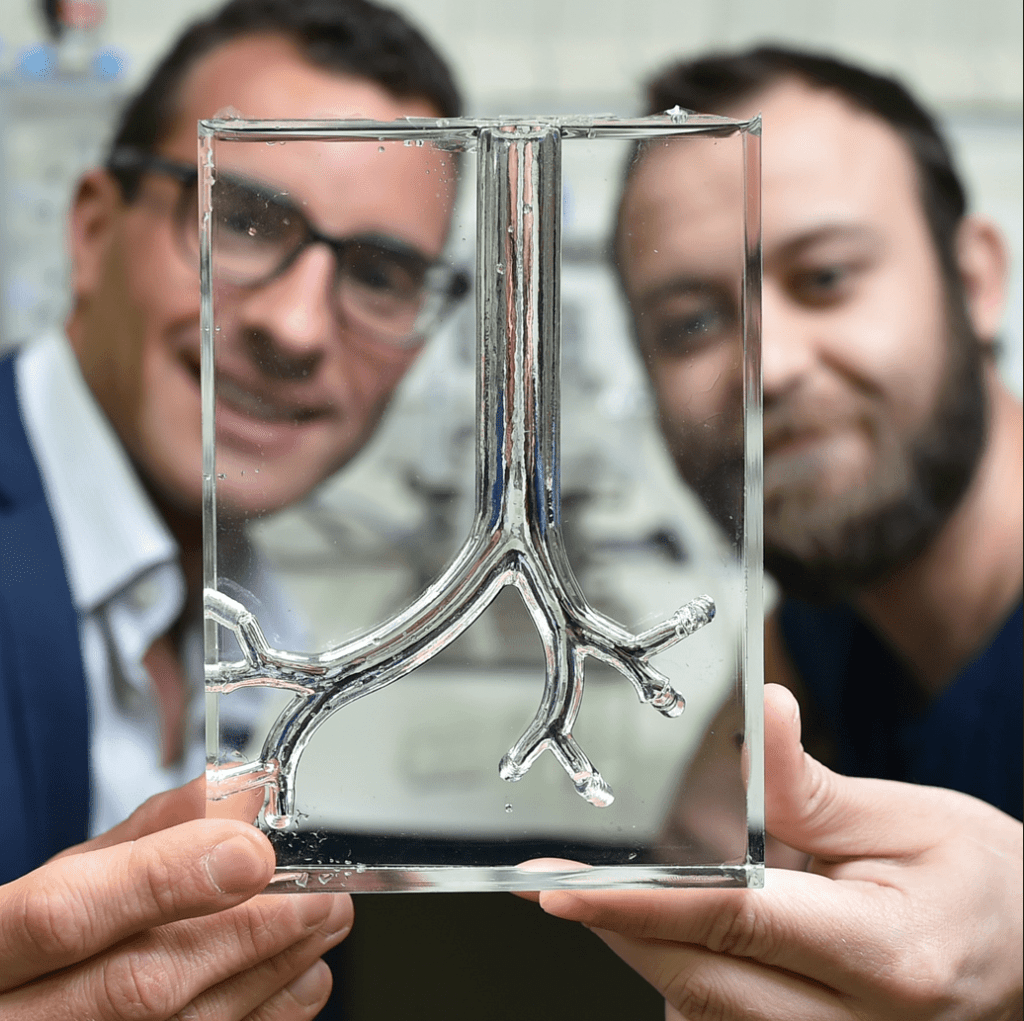
The device makes use of virtual channels, a concept presented by the same team a year ago in a paper published in the Proceedings of the National Academy of Sciences, wherein unique flow fields can be generated in a microfluidic chamber using electric field actuation. In their latest findings, the authors used this technology to create bidirectional flows – alternating stripes carrying fluid in opposite directions. Such a flow field is impossible to create using traditional pumps and valves, and when particles are introduced into this flow they behave in a well-explained yet initially non-intuitive manner: small particles remain stationary, while large particles flow away quickly.
“We know that all particles in a fluid move in random directions in a process called Brownian motion” said Vesna Bacheva, a PhD candidate in the Technion Faculty of Mechanical Engineering, and a co-first author of the paper. “This is the same mechanism that allows us to smell a small drop of perfume from across the room – the molecules simply make their way randomly in a process also known as diffusion. However, small particles diffuse much faster than large ones, and when placed in the bidirectional flow they move across the opposing flow streams very quickly. This makes them move very slightly back and forth but overall – stay in place. Larger molecules or particles diffuse much slower and end up being carried away by the flow.” The team calls their method BFF, meaning “bidirectional flow filter.” This separation mechanism was defined by one of the paper reviewers as “a fundamentally significant contribution to the field that only comes along every 10-20 years.”
“It really is very simple,” added Dr. Federico Paratore, postdoctoral researcher at IBM Research in Zurich, who also co-first authored the paper. “Surprisingly, it hasn’t been done so far, most likely because of technological limitations. Whereas developing the concept certainly took time and iterations, with today’s microfabrication capabilities the final device is rather a simple solid-state device that can be produced on a large scale”.
In the paper the team demonstrated the separation of antibodies and particles from small molecules and provided the theory and engineering guidelines for separation of wide variety of biomolecules. “The reason this might be very useful is because the majority of biological assays rely on a reaction between a probe and the target molecule in the sample, followed by removal of the excess probe molecules that did not find their target. This last step is often very involved and is extremely challenging when the volume of the sample is small,” said Prof. Moran Bercovici. “Our method does this very well, provided that the two reacting elements are of sufficiently different size.”
The team is currently working to adapt the method for rapid detection of the novel Coronavirus.
Dr. Govind Kaigala explained the concept: “Fortunately, the coronavirus is fairly large – about 100 nm in diameter. This is much larger than antibodies or other probes that can be used to bind to it. Using our method we hope to be able to place a patient’s sample into our chip where it will mix with visible probes, and then see only the viruses flowing out while the unbound probes stay behind.”
This work was funded by the European Research Council (MetamorphChip) and by the BRIDGE program (project 40B1-0_191549), funded by Innosuisse and the Swiss National Science Foundation.
Click here for the paper in Angewandte Chemie


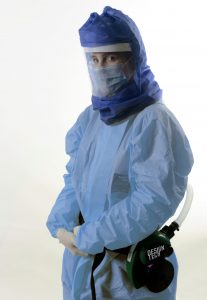 Prof. Ezri Tarazi, Chair of the Industrial Design Program and head of the Design-Tech Lab at Technion, together with doctors at the Clinical Research Institute at Rambam Health Care Campus, have developed a breakthrough device that dramatically improves the efficacy of protective masks worn by COVID-19 medical staff everywhere. Body temperature often causes condensation to build up inside the protective gear, which makes the masks fog up, so that it is difficult for medical staff to see properly when treating patients. There is additional concern that current protective masks are not sufficiently effective at eliminating infection by the virus aerosol droplets.
 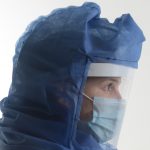 Medical staff worldwide report that problems of overheating and foggy glasses are among the additional challenges that make it difficult for the medical staff to care for COVID-19 patients. Prof. Tarazi based the idea on pumps used in the IDF protective masks against nuclear, biological and chemical (NBC) warfare, and adapted them to the needs of the medical professionals. “We integrated a thin flexible tube, a lightweight manifold, a thin shield and a rechargeable battery. All the components already existed, except for the manifold, which is being specially manufactured at Technion using Hewlett Packard industrial 3D printers.”