


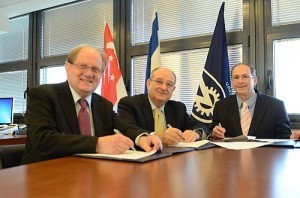
 Two renowned universities, the Nanyang Technological University (NTU), Singapore, and the Technion-Israel Institute of Technology, inked an agreement on 10 February 2013 to set up a collaborative program in satellite and space research.
The signing of the Memorandum of Understanding will allow for the sharing of resources and enhance opportunities for student and faculty exchange. It also comes at a time where both NTU and the Technion have embarked on plans to launch a Nano satellite over the next five years. Both universities have identified potential areas of research, including the study of electric propulsion systems that maintain the orbit control of a Nano satellite.
The two universities will also participate in each other’s satellite programs – namely the Technion IIT’s Space Autonomous Mission for Swarming and Geolocation Nano satellites (SAMSON) program and NTU’s VELOX program. A student exchange program for undergraduates and postgraduates from both institutions is also in the works.
The Agreement was signed by NTU President, Professor Bertil Andersson, and Technion IIT President, Professor Peretz Lavie at the Technion campus in Haifa, Israel.
“This MoU brings together two established technological universities with similar goals in space and satellite research,” says Professor Andersson.
“The agreement will increase contact and mutual support between students and researchers of Technion and NTU, as well as strengthen exchange opportunities at the two universities”.
“The Technion is delighted to explore yet another collaboration with NTU, one of the leading technological universities in the world, ” says the Technion president, Professor Peretz Lavie.
“Combining the knowledge and talents of our institutes will ensure the high quality and excellence of the scientific and technological leaders in Singapore and Israel”.
Both universities have established programs in space research, with NTU having launched the X-SAT microsatellite in 2011 and the Technion launching its Gurwin-II TechSat microsatellite in 1998.
Above (left to right): Prof’ Bertil Andersson, Prof’ Peretz Lavie, and Prof’ Oded Shmueli, executive vice president for research (Technion)
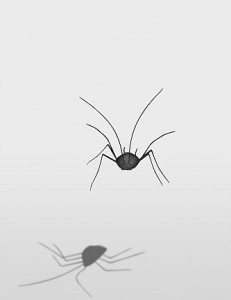 A joint multidisciplinary study conducted by researchers from the University of Haifa (Dr. Moshe Gish and Professor Moshe Inbar from the Department of Evolutionary & Environmental Biology) and the Technion (Dr. Gal Ribak and Research Professor Daniel Weihs from the Faculty of Aerospace, and the Technion Autonomous Systems Program (TASP)), found that aphids (known as plant lice), which drop from the host plant as a defensive response to danger, are capable of turning themselves over in mid air to almost always land on their feet. The study, which describes the aerodynamic mechanism and the ecological significance of this phenomenon, was recently published in the Current Biology Journal.
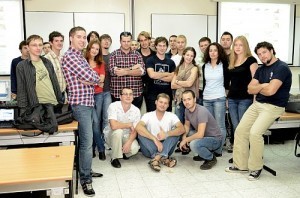 37 young men and women from Russia to study information technology security at Technion
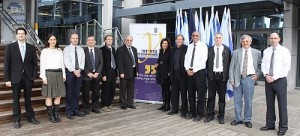 The Technion decides that a lecturer who does not meet the standards of good teaching – can no longer teach required courses
 Scientists from Technion and the University of Colorado, Boulder have taken a closer look at how stars systems and their planets grow old together.