“A new definition of crystal emerged, one that is beautiful and humble and open to further discoveries. A humble scientist is a good scientist.”
Author: shlomi ben-oz
Nobel Prize Chemistry 2011 Award Ceremony Speech
Transcript:
Award Ceremony Speech
For three millennia we have known that five-fold symmetry is incompatible with periodicity, and for almost three centuries we believed that periodicity was a prerequisite for crystallinity. The electron diffraction pattern obtained by Dan Shechtman on April 8, 1982 shows that at least one of these statements is flawed, and it has led to a revision our view of the concepts of symmetry and crystallinity alike. The objects he discovered are aperiodic, ordered structures that allow exotic symmetries and that today are known as quasicrystals. Having the courage to believe in his observations and in himself, Dan Shechtman has changed our view of what order is and has reminded us of the importance of balance between preservation and renewal, even for the most well established paradigms. Science is a theoretical construction on an empirical fundament. Observations make or break theories.
The Nobel Laureate of Former Disgrace
“Each time I was promoted there were colleagues fighting it…”
Israeli professor Dan Shechtman was vilified for daring to challenge scientific orthodoxy
Read the full story at the Jewish Chronicle
By Nathan Jeffay, December 9, 2011
Shechtman at the Technion in Haifa, where his eureka moment led to a new theory about the way matter is arranged
It could be the closing scene of a feel-good film. But it will happen for real, tomorrow afternoon. Israeli scientist Dan Shechtman, mocked for years for his off-the-wall theory, has not only been proved correct, but he will climb to the podium at Stockholm Concert Hall and receive the Nobel Prize for chemistry. The award is often shared by several people , but he has it all to himself.
During an interview in his Haifa office shortly before travelling to Stockholm, Shechtman recalled the initial reaction to the work that earned the prize. His research-team leader gave him a bit of a talking to. “He came to my office and put a textbook on my desk, smiling sheepishly and telling me that I should read it, as what I was saying was impossible.”
Shechtman, a 70-year-old professor of materials engineering at the Technion – Israel Institute of Technology, is a modern-day Archimedes. While most Nobel winners receive their prize after painstakingly developing a theory or idea over years, like the ancient scholar who got into the bath and saw the water level rise, Shechtman had a eureka moment.
It was the morning of April 8, 1982 and he was on sabbatical from the Technion at the National Bureau of Standards in Washington DC. He looked through his electron microscope, and found something that defied the laws of science, as they were understood.
Each time I was promoted there were colleagues fighting it
Until then, it was believed that atoms are always arranged in solids in symmetrical patterns, in groups of two, three, four or six. But he was looking at an alloy and found that it contained atoms in groups of 10 around a single point. They made a pattern that did not repeat itself, flying in the face of received wisdom that patterns will always be repeated. These formations became known as “quasicrystals” – and now represent a branch of science studied worldwide.
The Nobel committee said when announcing the award that Shechtman had “forced scientists to reconsider their conception of the very nature of matter”. But to get there was a long and sometimes humiliating battle. The team leader who demanded that he reread the textbook decided that he was bringing “disgrace” to his team and expelled him. Shechtman, who had dreamed of scientific accomplishment ever since his childhood, was not discouraged. “You can say it’s funny or you can say it’s stupid, but I showed everyone who was prepared to listen,” he recalls. “I even sent Chanucah cards with the pattern on them.”
When he returned from Washington in late 1983 he found many colleagues sceptical about his theory, but discovered an ally in the form of Ilan Blech, a professor in the faculty of materials science. This gave him the confidence to write an article on his findings and submit it to the Journal of Applied Physics. It came back with a rejection letter. “The editor didn’t even send it for peer review,” he says sadly. An improved version written with three collaborators, including Blech, was accepted by Physical Review Letters and published in 1984.
“Hell broke loose,” Shechtman recalls. He started receiving letters from scientists across the world saying they had be able to replicate his experiment, but there was also a very strong critical reaction. The International Union of Crystallography and the American Chemical Society led it. In their view, the fact that quasicrystals could only be seen on electron microscopes and not x-ray microscopes undermined the findings, and they believed that he was really looking at two structures of atoms and misreading it as a single one.
Leading the opposition was the only man ever to have won two Nobel Prizes, American chemist Linus Pauling. He reportedly used to say: “There is no such thing as quasicrystals, only quasi-scientists.” Even in Shechtman’s own department at the Technion, “there were professors fighting against my promotion and each time I was promoted there was opposition,” he says.
It was not until 1987 that his findings started to become mainstream. Two groups of scientists managed to identify quasicrystals on an x-ray microscope. He recalls going to the International Union of Crystallography after this breakthrough. “They said: ‘Danny, now you’re talking’ and they accepted it.” When Pauling died in 1994, the opposition evaporated completely.
When the call came from the Nobel committee in October, he was told to keep the news a secret for half an hour, when it would be announced. “I sat at my desk for 20 minutes just looking around and thinking: ‘What does it mean?'” He was calm. “If you measured my heart rate now it is 60; I don’t know if at that moment it got as high as 61.” After 20 minutes he called his wife Zipora, a professor at Haifa University, “because she is always mad that I don’t tell her about prizes”.
He was, he says, completely unprepared for the euphoria at the Technion and his celebrity across Israel which followed. The pattern he discovered is the ultimate fashion statement at the Technion, where staff members wear ties decorated with it. Shechtman shows off a kippah with the pattern that a student crocheted for him to wear when addressing Jewish groups.
Asked what is the practical significance of his discovery, Shechtman gives a wry smile and says “very little”. Quasi-crystals have been used to make strong materials for razors and non-stick pans, but for Shechtman the important thing is the correction of an erroneous assumption about the world. In his opinion, “a humble scientist is a good scientist”, and by forcing a rethink on the basics, he believes he has made the scientific community more humble.
“The new definition of a crystal is a wonderful one, because it is humble,” he says. “It doesn’t say: ‘A crystal is…’ It says: ‘By a crystal we mean…'”
Shechtman’s personality fits his talk of humility. There is no ceremony – no waiting rooms or secretaries – when visiting his office. His hobbies confirm the impression that he is a patient man – he likes sailing and jewellery-making. He believes that there is a message for everybody in his prize. “If you find something, concentrate on it and try to see if it is real; listen to other people but if they aren’t interested, don’t take their words as fact. Continue to push your belief.”
The Quasicrystal Caucus
“The mostimportantthing about thequasicrystals istheir meaningfor fundamentalscience. They haverewritten thefirst chapter inthe textbooks ofordered matter.”
Prof. Sven Lidin, Professor of InorganicChemistry, Lund University. Member of the Nobel Committee for Chemistry
![]() |
| In the mid-1970s, mathematician Prof. Roger Penrose, of Oxford University, created an aperiodic mosaic, with a pattern that never repeats itself, with just two different rhomboid tiles (a fat rhombus and a thin rhombus). |
![]() |
|
The page in Dan Shechtman’s lab logbook recording his April 8th, 1982, discovery.
|
![]() |
| Meeting at the National Institute of Standards and Technology (NIST) in 1985 just months after shaking the foundations of materials science with publication of his discovery of quasicrystals, Dan Shechtman, winner of the 2011 Nobel Prize in Chemistry, discusses the material’s surprising atomic structure with collaborators. From left to right are Shechtman; Frank Biancaniello, NIST; Denis Gratias, National Science Research Center, France; John Cahn, NIST; Leonid Bendersky, Johns Hopkins University (now at NIST); and Robert Schaefer, NIST. |
200 years and nobody noticed?
“Shechtmanite,” after the man who led the field through conception and infancy. The name “Shechtmanite” carried the risk of humiliation if the material turned out to be “twinning” (the intergrowth of two separate crystals on a shared lattice), as claimed by Shechtman’s opponents.
Initially, however, Shechtman’s discovery was viewed with skepticism. “The scandal of
polywater was still in the air, and I feared for my scientific and academic career,” says Shechtman.
![]() |
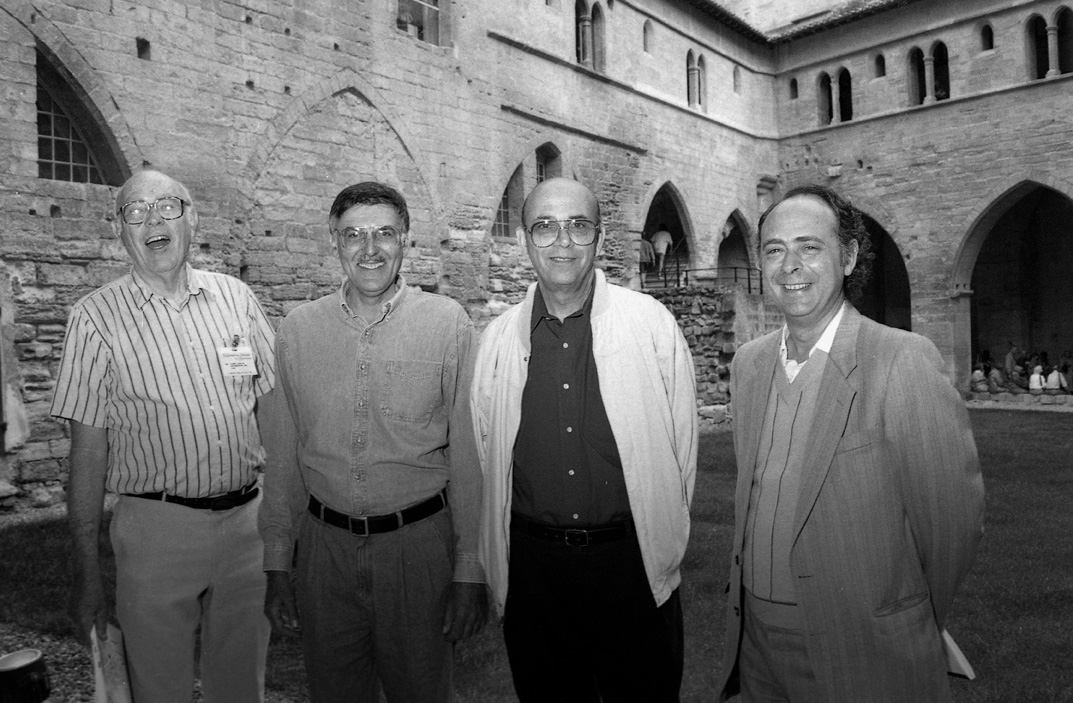
| (l-r) John Werner Cahn, Dan Shechtman, Ilan Blech and Denis Gratias together on the occasion of an international congress on quasicrystals in France, 1995. © CNRS Photothèque – Pierre Grumberg |
connection between a theoretical tenfold symmetry model proposed by Prof. Alan Mackay and Shechtman’s diffraction pattern, and developed the mathematical model for the structure of non-periodic icosahedral phases found in metallic alloys. Steinhardt and Levine published an article in 1984 where they described quasicrystals and their aperiodic mosaics.
![]() |
|
Dov Levine (left) with Paul Steinhardt (right)
at the Technion Faculty of Physics in 2006.
|
The Great Leviathan… Engineering Israel’s Energy Hope
Technion Leads the WayFrom: Technion Focus.
By: Prof. Shlomo Maital
“If Moses had turned right instead of left when he led his people out of the Sinai Desert,” goes an old joke, “the Jews would have had the oil and the Arabs would have ended up with the oranges.” We can’t tell that joke any more. Two major gas fields have been discovered offshore, in the Mediterranean, named Tamar and Leviathan. The latter is said to be the biggest gas find in the world in a decade.
Leviathan means “whale” in Hebrew and indeed is a whale of a find – new estimates show Leviathan has some 16 trillion cubic feet of gas, worth (at current European market prices, one cent per cubic foot) over $160 b. The Tamar gas field has an estimated eight trillion cubic feet of gas; it is located 90 km (54 miles) offshore, three miles deep, and its gas will reach Haifa in 2013. Leviathan is 130 km (78 miles) offshore. Many experts believe that in addition to the gas, there is also offshore oil.

The question now fiercely debated, is, what should Israel do with this new, incredible windfall? Liquify it and export it? Use it for gas-based industries, like petrochemicals? But first, a more pressing dilemma exists. Where will Israel find the hundreds of petroleum and natural gas engineers needed to bring the gas to shore safely and efficiently, and then process it optimally? This is a huge, enormously difficult and extremely costly challenge. Perhaps because Moses made that wrong turn, Israeli universities do not teach petroleum engineering.
That is, until now.
At the initiative of Technion President Prof. Peretz Lavie and Senior Executive Vice President Prof. Paul Feigin, Technion has moved with alacrity to launch a Master of Engineering program in Energy Engineering, with specialization in natural gas and petroleum engineering. The program is open for enrolment and formal studies will begin on December 28, 2011. For 18 months, some 25 engineers will study drilling engineering; production, transportation and storage engineering; or reservoir management, at their choice. Haifa University is an active collaborator through its Department of Marine Geosciences.
As Feigin notes, “the efficient, safe and environmentally responsible exploitation of [Israel’s] natural gas reserves is the major engineering challenge facing the State of Israel in the coming decades. The Technion, as it has done throughout its history, is taking the lead in providing the education and developing the know-how in order to meet this challenge.”
The director of the new program is Prof. Yair Ein-Eli of the Faculty of Materials Engineering. I asked him where the graduates of the program will be employed. He told me they would work for exploration companies (there may be vast additional reservoirs of oil and gas yet undiscovered), drilling groups, consulting companies, entities that process, transport and distribute the gas, and of course, for governmental ministries (Infrastructure, Finance, and Industry).
Finding top experts suitable to teach in this program was not easy. Technion found them at Technion itself, and at Haifa University, as well as at America’s University of Houston and Colorado School of Mines, and Norwegian Technological University. Both the U.S. and Norway have vast experience in exploiting oil and gas reserves.
Technion has a long history of anticipating Israel’s needs for engineering skills and with vision, supplying them. In November 1950, Prof. Sydney Goldstein, then head of the Aeronautical Research Council of Great Britain, arrived in Haifa to become dean of Technion’s fledgling Aeronautical Engineering Faculty. For a nation with barely a million people, and per capita GDP of $1,500, some thought this Faculty was folly. But 38 years later, on September 19, 1988, Israel became the eighth country in the world to launch a satellite. The effort was led by Technion-trained aeronautical engineers and students. Today space is a potential growth industry for Israel.
Technion petroleum and gas engineers will bring home the gas. Technion chemical engineers will show Israel how to best exploit this resource. And Technion graduates in management will lead the businesses that do so.
We owe Moses an apology for that tired joke. He knew precisely where he was going after all. In the end, we got the oranges – and the gas and oil as well.
Prof. Emeritus Shlomo Maital is a senior research fellow at Samuel Neaman Institute for National Policy Research, Technion. This article is based in part on Maital’s Marketplace column, Jerusalem Report, May 9, 2011.
© 2011 Technion-Israel Institute of Technology, Division of Publ
Google Search for Innovation. Result: Israel.
Blogged from Ynet.
Assaf Gilad, Calcalist
Published:11.14.11, 07:47 / Israel Business
Google is falling in line with other global companies and plans to establish a startup incubator for Israeli startup companies, scheduled to become operational next August.
Google will rent an entire floor at the Electra office tower in the heart of Tel Aviv. The initiative is scheduled to begin operating at the same time Google Israel headquarters and its R&D center move into the Electra tower as well.
The incubator will endorse 20 startups at a time which will rotate every few months. Google stresses that the technological incubator will be separate from the R&D center and operate as a community in its own right.
Google Israel will not invest in the companies in return for stock but it will assist them to procure loans and find guarantors.
Furthermore, Google will provide the startups with the utilities and infrastructure for their operations: Office space, meeting rooms, internet access, information services, tools and consultation from Google professionals, guidance from external bodies and experts as well as ancillary services such as legal, marketing and financial consultation.
The project will be headed by Amir Shavit, who is the company’s liaison with its developers in Israel, and Eyal Miller, head of business development at Google Israel.
According to head of R&D at Google Israel, Professor Yossi Matias, the incubator will welcome startups from various fields with an emphasis on open technologies, including from sectors which usually are not represented in Israel’s technology industry.
Google will establish a team that will work in cooperation with universities and colleges and most probably choose companies that can develop complementary products for Google’s products.
Recently a number of global companies have been establishing incubator-like initiatives, among them Red Hat, which announced last week it would launch a program to assist Israeli startup companies.
Other recently established initiatives include Genesis Fund’s Junction and Gil Ben Artzy’s UpWest Labs.
Israel’s Neuroscientists pool strengths for Alzheimers treatment
13 November 11 18:47, Gali Weinreb.
Avraham Pharmaceuticals Ltd., which is developing a treatment for Alzheimer’s disease, has raised $3 million. Eli Hurvitz’s Pontifax Fund, Clal Biotechnology Industries Ltd. (TASE: CBI), Yissum Technology Transfer Company of the Hebrew University of Jerusalem, and the Technion Research and Development Foundation have participated in the financing round. Prof. Marta Weinstock-Rosin of Hebrew University, the inventor of Exelon, made by Novartis AG (NYSE:NVS; LSE: NOV; SWX: NOVZ), also participated in the round.
Avraham Pharmaceuticals announced that it has begun Phase II clinical trials of its treatment, which is a new molecule in which components from two existing drugs are combined: Teva’s Azilect used to treat Parkinson’s disease, and Novartis’s Exelon used to treat Alzheimer’s disease.
The drug was developed by Teva for over ten years, but then returned to Yissum and the Technion because of patent considerations and the project was taking such a long time. Since then, the company has been re-established, has raised $9 million, and a few changes in the patent were made making it valid for a longer period of time. Teva has proven in clinical trials that the drug is safe and that it affects the body as expected, ie. causes a rise or fall in the level of chemicals associated with Alzheimer’s in the blood. The drug has not, however, reached the trial stage in which its benefit to real patients has been examined. Avraham Pharmaceuticals now has the responsibility to prove this.
In addition to its experiments concerning Alzheimer’s disease, Avraham Pharmaceuticals will soon begin clinical trials of a drug that treats mild cognitive impairment, which is thought to precede Alzheimer’s disease.
Yissum Technology has announced that its 30% stake in Avraham Pharmaceuticals (after the latest investment) will be transferred to a new holding company that it founded in the biotech field.
Sources inform “Globes” that besides Avraham Pharmaceuticals, the holding company will include six other companies that are currently conducting clinical trials: Tiltan Pharma, VCD, Autocas Bio, Lipicure, Algen Biopharmaceuticals and Novotyr Therapeutics. The holding company is called Integra and it is currently in the midst of a private financing round. Integra will be managed by Dr. Noa Shelach, a former Weizmann Institute Yeda manager, and CBI-Weizmann Institute Campus Bio project manager.
Published by Globes [online], Israel business news – www.globes-online.com – on November 13, 2011
© Copyright of Globes Publisher Itonut (1983) Ltd. 2011
Who are Israel’s 10 Nobel Laureates?
QuasiCrystals, Shechtmanite… Future Applications.
Surface CoatingsAn important area of application is the use of quasicrystals as materials for surface coatings, which benefit from the hardness of quasicrystals. The most prominent example is the use of quasicrystalline coatings in frying pans – an application famous in the quasicrystal community as it has served as a key example. Recently, quasicrystal-coated frying pans appeared on the market, and are sold by the French company Sitram under the trademark Cybernox.
Due to their particular physical and chemical properties, quasicrystalline coatings are suited for this kind of application. They are also rather cheap which makes them even more interesting for industrial applications.

Alloys Containing Quasicrystalline Nanoparticles
A different way to circumvent the brittleness of quasicrystalline bulk material while preserving some of its useful properties is the use of an Al-based alloy reinforced by precipitation of icosahedral particles in the nanometer range. Such materials, which are now commercially available in Japan, are of great technological interest as they can be strong but much lighter than other materials with comparable physical properties.
Examples of existing applications include razor blades and surgeon’s instruments, though this may have been more by chance than being an intentional application of quasicrystals. Experts predict that a similar use could soon find its way to the aviation industry.
Hydrogen Storage
A third, and maybe more speculative, application concerns the use of quasicrystals as a reversible storage medium for hydrogen. The most promising quasicrystal materials for hydrogen storage are Zr-based quasicrystals. For such systems, storage capabilities of almost two hydrogen atoms per metal atom have been reported, comparable to the storage capability of the Ti-Fe hybrides which have already been applied in non-polluting internal combustion engines. Further investigation are being carried out to reach the stage of industrial applicability.
See also: Quasicrystals and the Speed of Light.
The Technion Nobel Tradition
The Technion Nobel Laureates
| Lokey Park – a garden of trees planted by global Nobel Laureates at Technion City. |
| 1921: Albert Einstein initiates the Technion Nobel tradition. |
- Prof. Venkatraman Ramakrishnan, UK; Nobel Laureate in Chemistry, 2009
- Professor Ada Yonath, Israel; Nobel Laureate in Chemistry, 2009
- Professor Linda B. Buck, USA; Nobel Laureate in Physiology/Medicine 2004
- Prof. Avram Hershko, Israel; Nobel Laureate in Chemistry 2004
- Prof. Aaron Ciechanover, Israel; Nobel Laureate in Chemistry 2004
- Prof. Tim Hunt. U.K; Nobel Laureate in Medicine, 2001
- Prof. Kurt Wüthrich, Switzerland; Nobel Laureate in Chemistry, 2002
- Prof. Günter Blobel, USA; Nobel Laureate in Medicine, 1999
- Prof. Ferid Murad, USA; Nobel Laureate in Medicine, 1998
- Prof. Jean-Marie Lehn, France; Nobel Laureate in Chemistry, 1987
- Prof. David Gross, USA; Nobel Laureate in Physics, 2004
- Prof. Elie Wiesel, USA; Nobel Laureate in Peace, 1986
- Rita Levi-Montalcini, Italy; Nobel Prize in Physiology or Medicine, 1986
- Albert Einstein, Germany/USA at old site; Nobel Prize in Physics, 1923
Technion’s Nobel Laureates in Chemistry – Collect the stamp, and watch this space for a New Nobel Edition!
ISRAEL POST – INTERNATIONAL YEAR OF CHEMISTRY 2011
Ehud Keinan Professor of Chemistry Technion – Israel Institute of Technology, President of the Israel Chemical Society, Editor in Chief, Israel Journal of Chemistry, Chairman of the Chemistry Committee, Ministry of Education Dr. Joerg Harms of the University of Hamburg is acknowledged for the ribosome graphics.
Who is Dan Shechtman?
The Nobel Committee at the Royal Swedish Academy of Sciences
![]() |
| Dan Shectman in 1983, shortly after his discovery |
![]() |
| Dan Shechtman in 2010… still unravelling the implications. |
Dan Shechtman discovered the Icosahedral Phase in 1982. It is the first structure in the field of quasi-periodic crystals, and was discovered in aluminum transition metal alloys.
He instigated the course Technological Entrepreneurship in 1986, referring to it as “my baby,” and has overseen it annually ever since. The course is offered in the winter semester each year and comprises 14 guest lectures, some of which are inspirational talks delivered by successful Israeli entrepreneurs. Shechtman is invited to lecture worldwide about the Technological Entrepreneurship course, arousing much interest. He considers himself a missionary, “I coordinate the course with pleasure. I do it for Israel.”
“This is the Israeli spirit. Sometimes this leads to chaos; but free thinking encourages successful scientists. We are living here in a free society… many of us do not follow the rules, and this is part of the national character of a free-thinking people.”
Between 2001 and 2004, Shechtman served as chairperson of the sciences division, Israel Academy of Sciences and Humanities. Now as a member, he continues to oversee the translation of the Nobel Prize scientific posters into Hebrew, and their annual distributes to schools throughout the country.
Shechtman has been voted as an outstanding lecturer by his students at the Technion for ten years consecutively. He is married and lives in Haifa. He has four children and nine grandchildren.
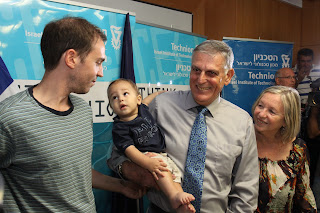
| Shechtman with his family after the spontaneous press meeting at Technion (Oct. 5th, 2011). |
The Path to the Nobel Prize: Shechtman Timeline.
![]() |
| Seeing is believing, or not? |
![]() |
| Technion President Prof. Peretz Lavie with Prof. Dan Shechtman at the Nobel Prize press conference (October 5th, 2011) |
1966
Shechtman receives his Bsc from Technion.
1968
Shechtman receives his Msc from Technion.
Shechtman receives his Phd from Technion.