


Toward Smart Light Sources
Researchers at the Technion have uncovered the connection between the properties of luminescent materials and the characteristics of the light they emit
Technion researchers have developed, for the first time, a comprehensive physical model explaining how the properties of a radiating material, including absorption, emission, and quantum efficiency, affect the fundamental characteristics of the light it emits as a function of temperature. In essence, the emitted light changes its color, intensity, and randomness according to the material’s properties and its temperature. The discovery was published in Optica and opens new possibilities for designing advanced light sources, optical sensors, and thermally based photonic systems.
The research was led by M.Sc. student Tomer Bar-Lev and Prof. Carmel Rotschild from the Faculty of Mechanical Engineering and the Russell Berrie Nanotechnology Institute at the Technion. According to the researchers, the central phenomenon examined in this work is photoluminescence, a process in which a material emits light in response to incident illumination. In this phenomenon, light particles (photons) are absorbed by the material and re-emitted, forming the basis of many technologies, including LED lighting and optical sensors.


The Technion researchers demonstrated that the influence of fundamental physical laws formulated more than a century ago is far broader than previously thought.
At the beginning of the 20th century, physicist Max Planck showed that a body in thermodynamic equilibrium emits radiation depending on its temperature and material properties. Another German physicist, Gustav Kirchhoff, showed that under the same conditions, a material’s absorption and emission properties must be identical. The new work by Technion researchers extends beyond the specific case of thermal radiation to all types of radiation, generalizing the relationship between matter and radiation out of equilibrium. Moreover, in their pioneering Optica paper, they present a general equation that enables prediction and, crucially, design of the nature of light emitted from luminescent materials.
The new model describes how increasing temperature gradually transforms the emitted light, from well-defined, narrowband emission, such as that of an LED, to broad, multicolored radiation like sunlight. In doing so, the model fully explains, for the first time, how these two phenomena are fundamentally connected.
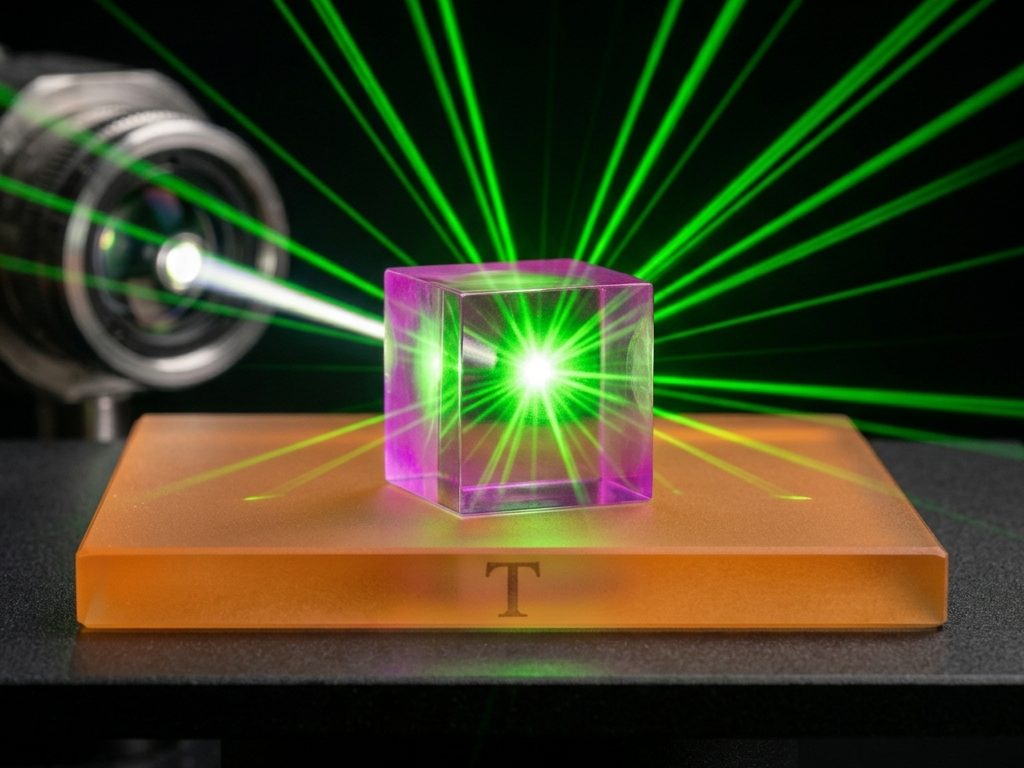
This scientific discovery paves the way for controlling the properties of light simply by adjusting temperature. Potential future developments include advanced optical devices, communications technologies, precise sensing, and applications in optical cooling and heat management. According to Prof. Rotschild, “The model we developed provides a broad foundation for understanding light properties and for designing radiation sources with the material characteristics we desire. It offers a new physical framework for the light sources of the next generation.”
The research, supported by the Israel Science Foundation (ISF), places the Technion at the forefront of global research at the intersection of physics, thermodynamics, and photonics.
To read the full article, click here

