

The Samba Dance of a Single Photon: A Breakthrough on the Path to Quantum Computing and Communication
A team of researchers from the Technion, Shanghai, and other laboratories in China has developed a new way to control a single particle of light, known as a photon. The breakthrough was led by Prof. Erez Hasman’s Atomic-Scale Photonics Laboratory at the Technion Faculty of Mechanical Engineering and Helen Diller Quantum Center, together with Prof. Bo Wang and other collaborators in China.
Using a structure called a quantum metacavity, the researchers were able to precisely control a property of light known as angular momentum, which can be thought of as the way a photon twists or rotates as it travels.
Prof. Wang conducted his postdoctoral research in Prof. Hasman’s laboratory at the Technion and contributed to the laboratory’s breakthroughs in geometric-phase-based spin lasers and two-dimensional materials.

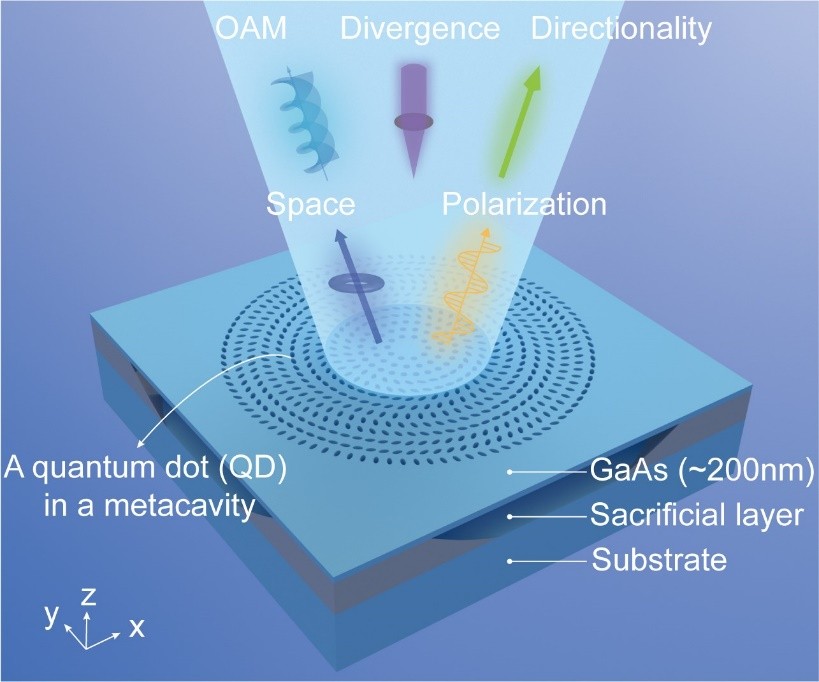
Single photons are the building blocks of future quantum technologies, and one of the challenges in this field is combining their generation with control over their degrees of freedom and the way they propagate. Prof. Hasman and his colleagues addressed this challenge using a quantum metacavity – a tiny structure only about 200 nanometers thick, with a quantum dot at its center that serves as a “factory” for single photons. The cavity significantly enhances light-matter interaction, and using a metastructure based on geometric phase, the researchers demonstrated the ability to lock the photon’s spin and manipulate its angular momentum. The study was published in Physical Review Letters.
Two fundamental properties of photons are orbital angular momentum and spin, the latter often described colloquially as “spinning.” In the new system, the researchers succeeded in creating a “locking” between a photon’s spin and its direction of motion, generating vortex beams with angular momentum, and even producing holograms using single photons. In other words, instead of obtaining an “ordinary” particle of light, the new device makes it possible to predetermine what the photon will look like, where it will travel, and what information it will carry.
The physical effect responsible for splitting the spins of single photons in the quantum metacavity is based on the optical “Rashba” effect, discovered by Prof. Hasman and inspired by the well-known effect in electrons. Using a cavity structure with broken inversion symmetry, linear momentum that depends on spin can be imparted to individual photons.
The source of the single photons is a quantum dot located at the center of the cavity. A quantum dot is a tiny semiconductor particle that obeys the laws of quantum mechanics and has the unique ability to control the wavelength it emits according to its physical size. A quantum dot is also known as an artificial atom because its energy levels are discrete, much like those of real atoms.
The quantum metacavity developed by the researchers could contribute significantly to the development of quantum computers, highly sensitive quantum sensors, quantum encryption, and the transmission of information using quantum statistics. The photon’s spin and orbital angular momentum serve as degrees of freedom that are essential for encoding information.
For more information about the work of Prof. Erez Hasman’s laboratory, visit the laboratory website: https://hasman.technion.ac.il/
Metacavity Quantum Electrodynamics, Physical Review Letters 137, 023601 (2026)
DOI: https://doi.org/10.1103/j8gx-58hf
Below, a quantum metacavity with a quantum dot at its center, enabling control of a single photon’s spin, orbital angular momentum, and phase. The photon’s spin-orbit coupling is achieved using a metasurface-based cavity (dielectric nanoantennas) with broken inversion symmetry, which enables the optical “Rashba” effect to be applied to a single photon. The dependence of a ball’s trajectory on its spin can be viewed as an analogy for the photon spin-orbit coupling effect, as seen in sports such as tennis, table tennis, and the “banana kick” in soccer. The study exploits full control over all the photon’s degrees of freedom to create a quantum hologram using single photons.