

The Next Generation at the Technion Presents: Applied Medicine
Participants in the T2MED 2026 hackathon led the development of innovative solutions in human health. The top three winning teams presented groundbreaking ideas for a home kit to detect occult blood, tissue-monitoring following transplantation, and early-monitoring software for depression and anxiety
The Technion recently hosted T2MED 2026, the 12th Medical Entrepreneurship Hackathon of the Ruth and Bruce Rappaport Faculty of Medicine. More than 70 students from the fields of medicine, engineering, and science came together to tackle real clinical needs and envision the medicine of tomorrow.
The journey began with an orientation day at Rambam Campus and continued with three intensive hackathon days during which teams developed their ideas, built prototypes, and presented them to a broad panel of judges from the medical and industrial sectors.
The hackathon was divided into four tracks: innovation in operating rooms, diagnostics and early detection, emergency medicine, and healthcare systems management.
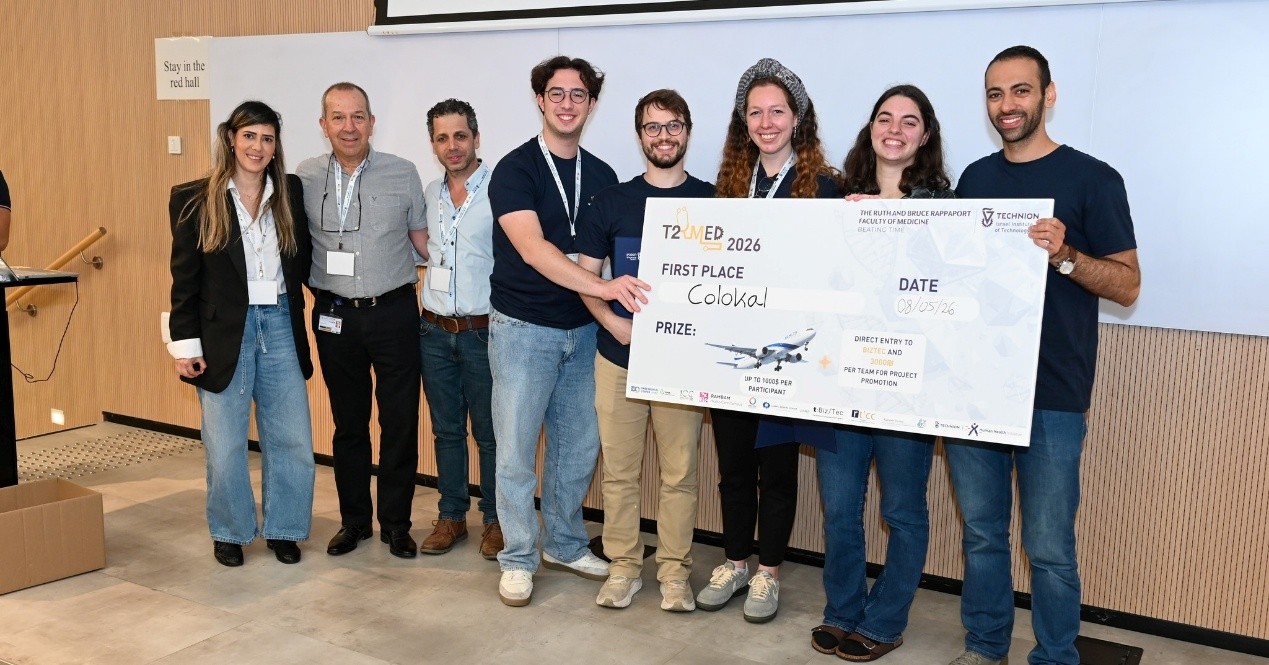
First place was awarded to Team Colokal, which developed a home kit for detecting occult blood (microscopic traces of blood in stool that cannot be seen with the naked eye) in stool that does not require patients to come into contact with the sample or transport it to a pharmacy. Colokal was developed by Tamar Cohen Sapir (Medicine, fourth year), Eylon Hotam (Computer Science, first year), Maya Kozlovski (Chemistry, master’s degree), Omri Leshem (Materials Science and Engineering, master’s degree), and Idan Orgad (Medicine, fourth year).
The first-place winners received $1,000 per team member for overseas travel, as well as an additional NIS 3,000 for the group to further develop the project, sponsored by BizTec.
Second place was awarded to Team LARScan, which developed a patch for continuous monitoring of tissue viability following free flap surgery. The patch enables early detection to support effective real-time intervention. LARScan was developed by Shirel Daoudy (Medicine, fourth year), Artemiy Rubtsov (Electrical and Computer Engineering, second year), Rotem Shmueli (Medicine, third year), and Lior Shor (Biomedical Engineering, master’s degree). The second-place winners received Garmin watches for each team member.
Third place went to Team FireFly, which developed an application for identifying early signs of depression among children. FireFly was developed by Roni Altshuler (Biology, PhD candidate), Rachel Folger (Medicine, third year), Michael Hubner (Electrical and Computer Engineering, fourth year), and Adee Shamir (Medicine, master’s degree). The third-place winners received coffee machines for each team member.
In addition to their prizes, the top three teams will advance to the semifinals of the national BizTec competition.
The Innovation Prize, worth NIS 1,800, was awarded to Team LuminOR, which developed a thermal camera system for detecting infection sites between surgeries. LuminOR was developed by Asaf Bittan (Medicine, PhD candidate), Gal Shamis (Biotechnology and Food Engineering, fourth year), Adam Vichik (Electrical and Computer Engineering, fourth year), and Shaked Yitzhak (Electrical and Computer Engineering, master’s degree).
The Impact Prize, worth NIS 1,000, was presented to Team Pitt, which developed a wearable vest integrated with an AI-based avatar that provides real-time anxiety protocols and continuous monitoring of vital signs from the moment the patient arrives at the clinic. Pitt was developed by Alisa Goverdovsky (Biotechnology and Food Engineering, second year), Juliet Nassour (Medicine, fourth year), Yuting Yang (Mechanical Engineering, master’s degree), Hadas Yaron (Medicine, first year), and Tal Yavits (Biomedical Engineering, first year).
The Impact Prize was awarded in memory of the late Prof. Yoram Palti, a graduate and faculty member of the Faculty of Medicine, Israel Prize laureate, pioneer in cancer treatment, and founder of Novocure. Remarks in his memory were delivered by his daughter, Dr. Dafna Palti, who described life in the Palti household as an endless hackathon of entrepreneurship and innovation.
The hackathon was organized by Stephanie Shneor, Shai-Lee Cohen, Dr. Lior Lev-Tov, Shahaf Lalo, Mahmoud Ikteelat, Ella Furman, Lior Romano, and Adi Yankovich. Sponsors, professional mentors, and supporting organizations included the medical centers affiliated with the Faculty of Medicine (Rambam, Carmel, Bnai Zion, Emek, and Hillel Yaffe), the Technion Human Health Initiative, the Rappaport Integrated Cancer Research Center (RTICC), the Rappaport Family Institute for Research in the Medical Sciences, Base44, Peregrine Ventures, HiCenter, and additional partners.
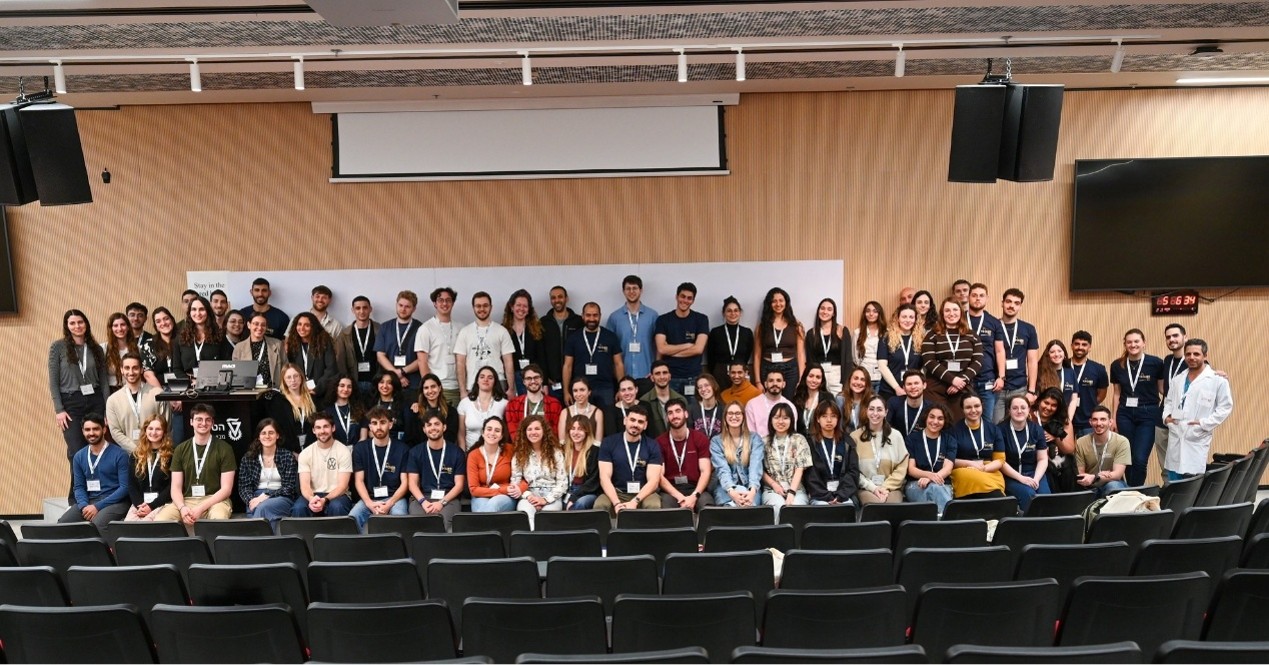
Photo credit: Erez Hayun.