


The Athlete Who Dreamed of Becoming an Archaeologist – and Won the Nobel Prize in Physics
Prof. Reinhard Genzel, who won the 2020 Nobel Prize in Physics for discovering the black hole at the center of the Milky Way Galaxy, met with students at the Technion and planted a tree on the campus’ “Nobel Laureates Avenue”
Prof. Reinhard Genzel, Nobel Prize laureate for 2020, recently visited the Technion-Israel Institute of Technology. During his visit, Prof. Genzel met with the incoming Dean of the Faculty of Physics, Prof. Eric Akkermans, delivered a lecture in the Faculty, met with graduate students, and then planted a tree on the Technion’s “Nobel Laureates Avenue,” where more than twenty trees have been planted by Nobel Prize laureates.

This was not Prof. Genzel’s first visit to the Technion. In 2014, the Technion awarded him the Harvey Prize in Science and Technology for proving the existence of a black hole at the center of our galaxy (i.e., the Milky Way Galaxy). The Harvey Prize is the most prestigious award granted by the Technion, and over the years, it has become known as a “Nobel predictor,” since more than 30% of its recipients have gone on to win the Nobel Prize. This was the case with Prof. Genzel, who received the Nobel Prize six years after winning the Harvey Prize. Since then, Prof. Genzel has visited the Technion several times.
Born in Germany in 1952, Prof. Genzel is the director of the Max Planck Institute for Extraterrestrial Physics in Garching, Germany. Until the age of 15, he believed he would become an archaeologist. “In the end, I arrived at a similar field,” he told Technion students, “after all, both archaeology and astrophysics deal with the study of the past.” He was also interested in sports and was even selected for Germany’s Olympic team in javelin throwing. A severe elbow injury cut short this promising athletic career and dashed his dream of participating in the Munich Olympics. Nevertheless, he said that “Sports gave me excellent tools for life, especially the understanding that you must work hard and know how to get up after failures.”
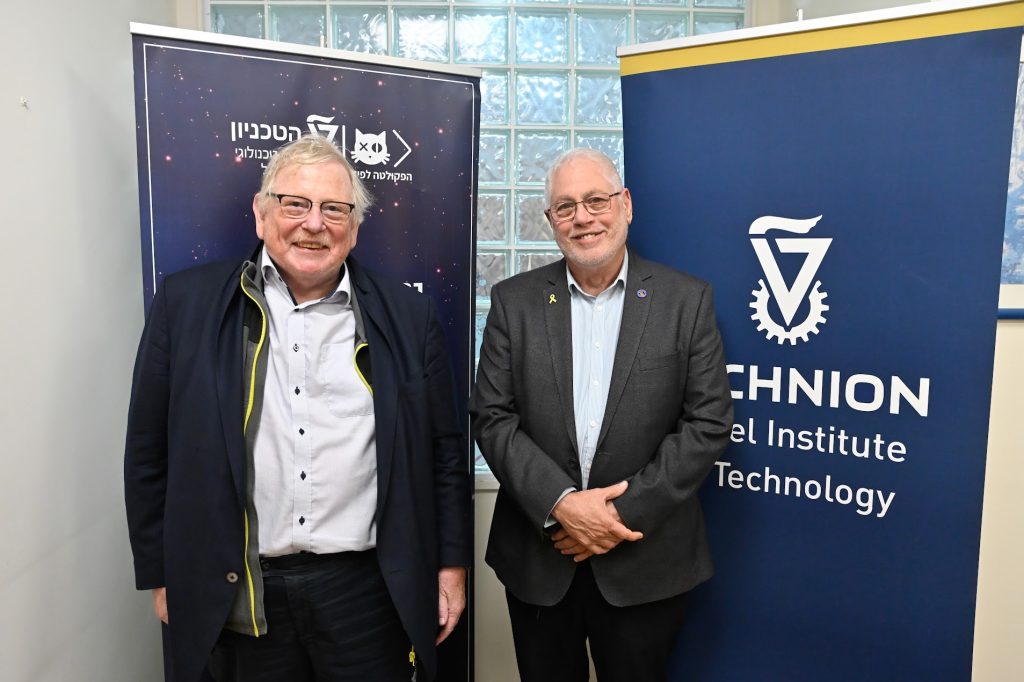
Before the lecture in the Faculty of Physics, Prof. Hagai Perets spoke in glowing terms about Prof. Genzel. “In my view, his greatness as a person is no less than his greatness as a scientist,” said Prof. Perets. “As a doctoral student, I remember how accessible he was to students, how much he enjoyed meeting them and helping them. His support for Israel over many decades, and especially since the events of October 7, attests to his exceptional character.”
“My visits here, and my friendships with colleagues at the Technion and in Israel in general, are a great privilege,” said Prof. Genzel. “I see many curious students here in the audience, and I promise them that the Technion is an excellent place for high-level learning.”
“Black holes were part of Einstein’s general theory of relativity,” said Prof. Genzel. “According to Newton’s classical physics, if a photon (a particle of light) passes near a mass, it will not be affected by it and will not change its path. According to Einstein, by contrast, the photon will be influenced by the mass and will deviate from its trajectory; and if the mass is particularly large, the deviation will be especially large. In such a case, regions form in space from which photons cannot escape. These are black holes.”
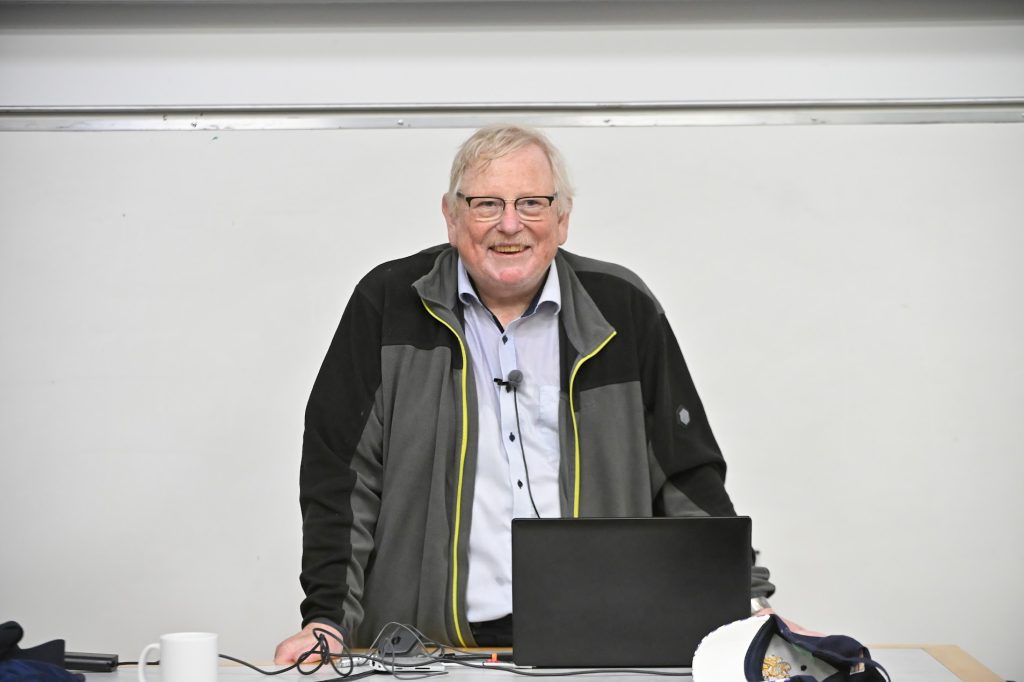
Since the publication of the general theory of relativity in 1915, significant breakthroughs have been made in its theoretical development, but experimental research has had to contend with numerous technological challenges – and this is where Prof. Genzel’s main contribution lies. Using the technologies he developed, Prof. Genzel succeeded in proving the existence of a black hole at the center of the Milky Way Galaxy and determined that its mass is four million times that of the Sun.
One of the technological challenges on the road to discovery was the optical challenge, since the radiation reaching the large telescopes on Earth passes through currents and turbulence in the atmosphere that distort the resulting image. The solution developed by Prof. Genzel and his colleagues combined infrared imaging, innovative optical technologies, and adaptive optics – a field that began developing in the 1980s and made it possible to correct the optical disturbances created by the atmosphere. Adaptive optics is based, among other things, on creating “virtual stars” using laser radiation and observing them telescopically; based on the data obtained from these observations, and the gap between them and the true properties of the “star,” it is possible to create a correction mechanism that neutralizes atmospheric distortions and provides a more accurate and sharper image of real objects in space.
“Prof. Genzel is a leading observational astrophysicist who has excelled in developing groundbreaking instrumentation,” explained Dr. Shmuel Bialy from the Technion Faculty of Physics, who organized the visit. “The success that led him to the Nobel Prize was based on instruments whose development he led. The most recent of these, GRAVITY, was launched in 2016 as part of the VLT (Very Large Telescope) in Chile. The instrument combines the signals from four telescopes, each with a diameter of 8.2 meters, and produces an image with exceptional resolution, equivalent to observations made with a gigantic telescope with a mirror diameter of 130 meters. This technology makes it possible to measure the positions of objects with an accuracy of up to 10 micro-arcseconds – like measuring, in a telescopic observation from Tel Aviv, the exact position of a grain of sand lying on a bench in New York.”
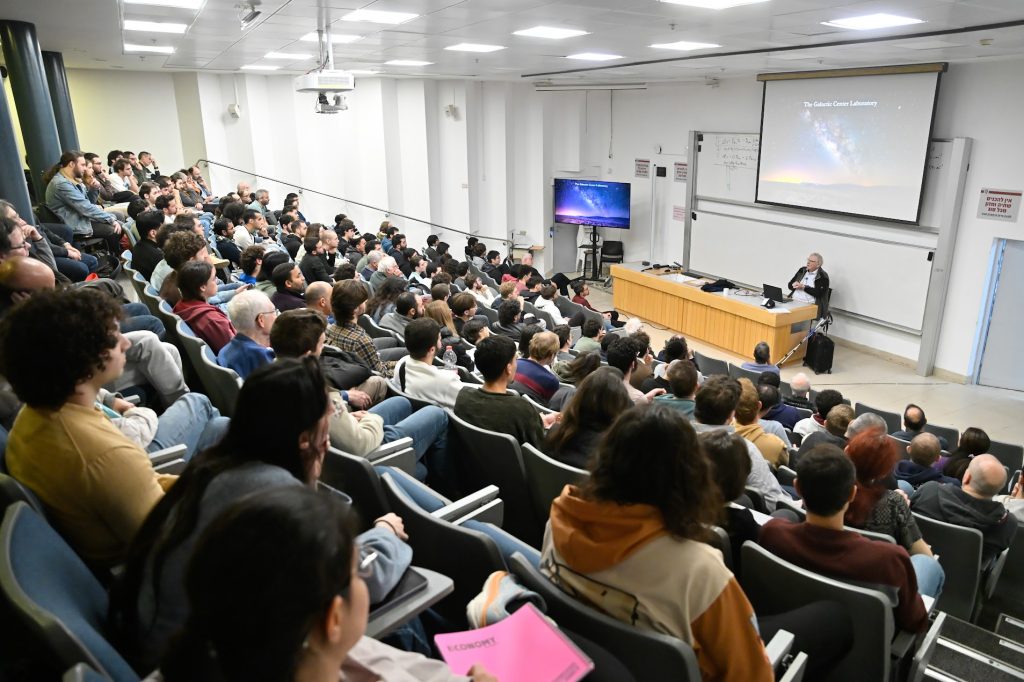
The technological advances led by Prof. Genzel enabled him and his partners to create pioneering observation systems and unprecedented discoveries. In October 2002, they published in Nature the findings they had collected over a decade and their central conclusion: at the center of the Milky Way galaxy, about 26,000 light-years from us, there is an object smaller than the size of the solar system but with a mass four million times that of the Sun. This discovery led to the awarding of the 2020 Nobel Prize in Physics to three scientists: Prof. Genzel and Prof. Andrea Ghez for the discovery of a “supermassive compact object at the center of the galaxy,” and Prof. Roger Penrose of Oxford for showing that “black holes are a robust prediction of the general theory of relativity.”
Prof. Genzel shared his scientific journey with the students. “The motivation to continue experimental research, with all its challenges, came to me from the many successes along the way. The Nobel Prize was never my motivation – and Prof. Charles Townes, Nobel laureate in Physics for 1964, made it clear to me early in my career that there are no Nobel Prizes in astrophysics. Later, when I received the Crafoord Prize in 2012 from the Royal Swedish Academy – the same academy that awards the Nobel Prize – they told me at the dinner after the ceremony that ‘you have no chance of winning a Nobel Prize – unless you present a truly earth-shaking discovery.’”
In the past decade, things have changed, and four Nobel Prizes in Physics have been awarded to astrophysics. One of them went to Prof. Genzel, who told the students that, “Even after the Prize, I continue to do science because that’s what I love. It’s not that nothing changes – the attention you receive following the award is hard to describe. And it doesn’t affect you only positively – suddenly, the media follows every word you say and looks for ways to create sensational headlines from your remarks. That requires great caution.”
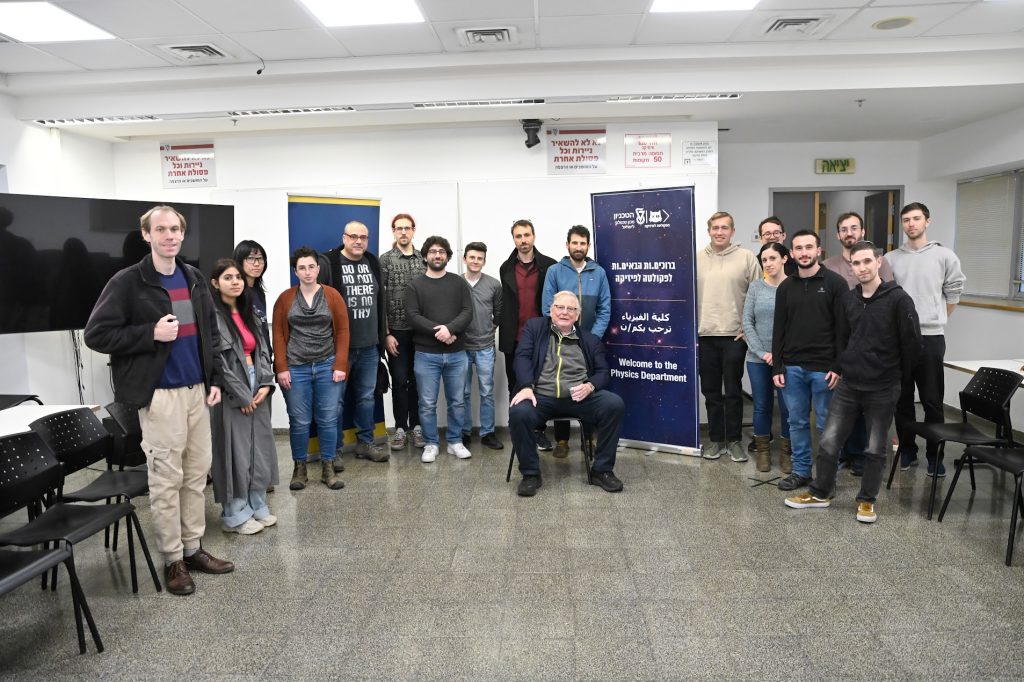
Photo credit: Sharon Tzur, Technion Spokesperson’s Office


