


Medicine from Within
Pioneering technology developed at the Technion enables the production of drugs inside the body using live bacteria
Technion researchers have developed an innovative approach that allows drugs to be produced inside the human body. The new technology, developed at the Faculty of Biotechnology and Food Engineering, uses live bacteria that manufacture the therapeutic substance. The researchers’ findings were recently published in Advanced Healthcare Materials.
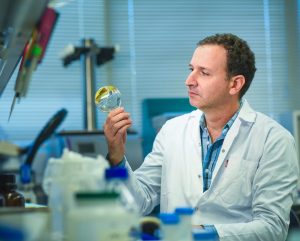
The research was led by Professor Boaz Mizrahi, Dr. Adi Gross, and Ph.D. student Caroline Hali Alperovitz. According to Prof. Mizrahi, “We are used to thinking that to introduce a drug into the body, it must be manufactured in a factory – sometimes on another continent – then formulated and finally administered to the patient via a capsule or an injection. Our paper describes a new paradigm for both drug production and consumption.”


This new paradigm is based on using harmless bacteria modified to produce and secrete the desired drug inside the body. These bacteria are introduced directly into the affected organ, where they manufacture and release the drug locally, eliminating the need for swallowing or injecting additional substances.
The technology offers several key advantages. First, the drug is always fresh, as it is used immediately after being produced – a major benefit for protein-based drugs and molecules sensitive to oxidation. Second, the drug’s bioavailability is higher due to the proximity of the “factory” to the “consumer,” reducing side effects caused by drug degradation during transport in the body. Third, because the bacteria replicate within the tissue, a single “dose” of bacteria may be sufficient for weeks, lowering treatment costs.
In their study, the Technion researchers used the non-pathogenic bacterium Bacillus paralicheniformis, which they modified to produce an important protein called γ-PGA. This protein plays a crucial role in healing severe wounds, improving skin appearance, and reducing inflammation.
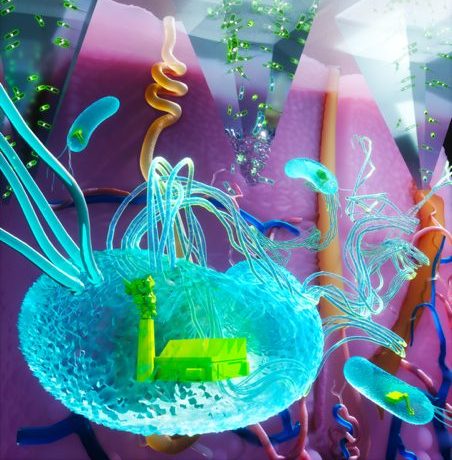
To deliver the bacteria into the body safely and painlessly, the researchers developed a microneedle patch. When applied to the skin, the tiny needles penetrate the dermal layer (dermis) without harming nerves or blood vessels. Contact with the dermis causes the microneedles to dissolve, releasing the bacteria and allowing them to function as a “smart biological factory” that produces the desired drug from available raw materials. Experiments confirmed the process works effectively, and the team optimized it with a nutrient medium providing the bacteria with essential materials. Detailed chemical analysis verified that the bacteria indeed produced a pure, active therapeutic substance.
To test the technology’s safety, the researchers applied the system to mice and found that their skin remained healthy, with the patch dissolving within just two hours, showing no signs of inflammation or tissue trauma.
“Large biological molecules and proteins are now used to treat a wide range of chronic and acute diseases,” explained Prof. Mizrahi. “Therefore, the innovative approach we developed could revolutionize the field of pharmaceuticals — instead of injections and pills, we could treat patients with a ‘living’ system that minimizes the need to repeatedly administer drugs, as is customary today.”
The research was supported by the Israel Science Foundation (ISF) and by the Russell Berrie Nano-technology Institute of the Technion.
Read the full article – here