

Dr. Yakir Vizel of the Technion wins the prestigious European ERC Consolidator Grant
The European Research Council (ERC) has announced that Assistant Professor Yakir Vizel, a faculty member in the Henry and Marilyn Taub Faculty of Computer Science, has been awarded the prestigious 2025 ERC Consolidator Grant.
Consolidator Grants are intended to support outstanding researchers who are developing pioneering and groundbreaking ideas during the phase of building their research team and work program. Each grant is valued at approximately €2 million.
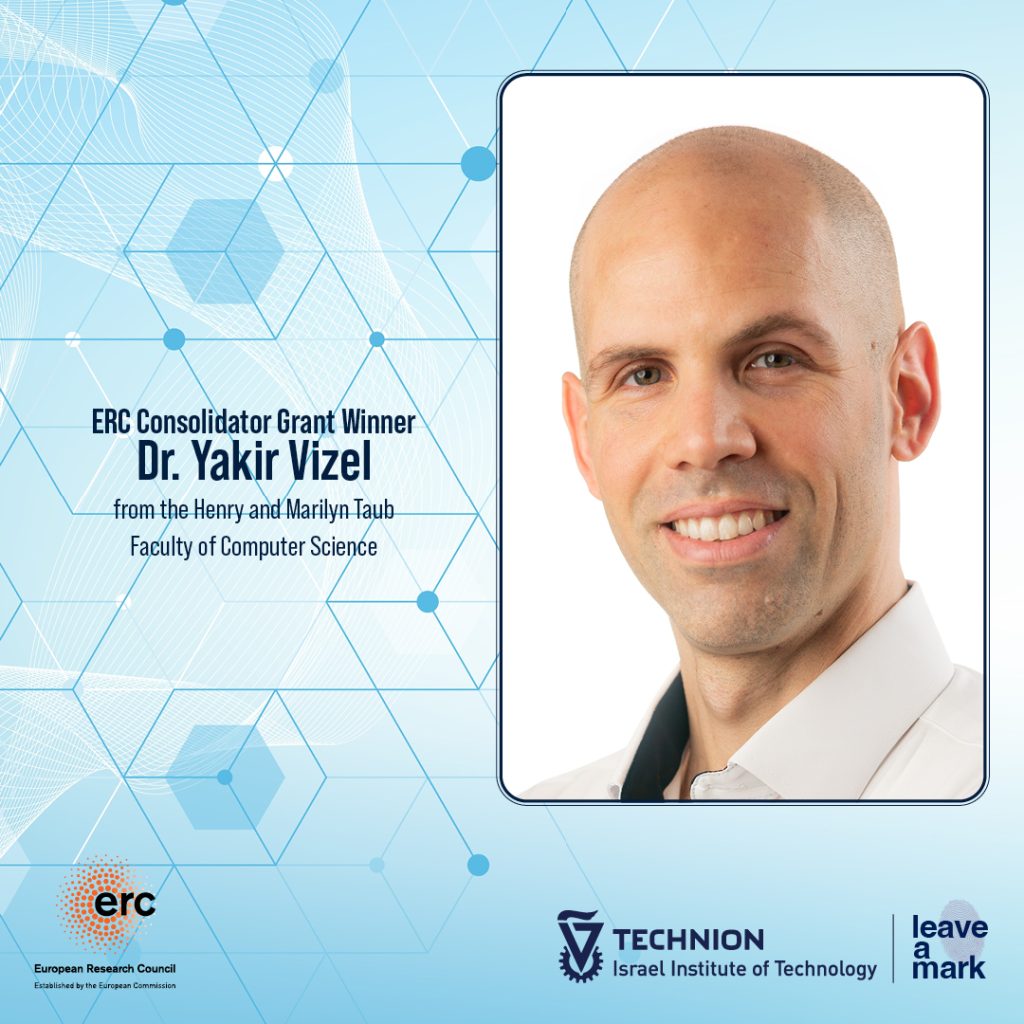
Dr. Vizel completed a joint bachelor’s degree in mathematics and computer science, and his Ph.D. in the Technion’s Taub Faculty of Computer Science. He then conducted postdoctoral research at Princeton University. He has worked at leading companies, including NVIDIA, Amazon (AWS), and Intel. His research bridges theory and practice and is therefore relevant to multiple technology industries.
Dr. Vizel will receive the grant to develop StrongMC – a framework designed to improve the reliability of complex computer systems such as processors, avionics, and space systems, autonomous driving platforms, medical devices, and more. His field of research, Formal Verification and Automated Reasoning, focuses on automatic mathematical methods for proving that computer systems behave correctly according to a given specification. Such a mathematical proof covers all possible behaviors of the system and therefore eliminates the need for testing. A real-world example: an early proof that an autonomous vehicle brakes safely and on time in an emergency, under any scenario.
The StrongMC framework aims to achieve a significant improvement in the runtime of formal verification algorithms, despite their computational complexity. According to Dr. Vizel: “Most existing algorithms use ‘weak’ proof systems – built from simple proof rules—to prove that a system satisfies the required specification. The desire for simplicity is clear: the simpler the proof rules, the easier they are to implement. However, using simple proof rules may lead to situations where the desired property cannot be proven within a reasonable time. We believe that using strong proof systems, built from more complex proof rules, can yield better results despite the challenges of implementing them. Our challenge is to utilize complex proof rules efficiently. I hope the success of this project will contribute not only to computer science but also to a range of real-world applications in various domains.”
Photo credit: Nitzan Zohar, Technion Spokesperson’s Office