

A paper by the Ramanujan Machine group from the Technion presents deep connections between different mathematical formulas for the constant π
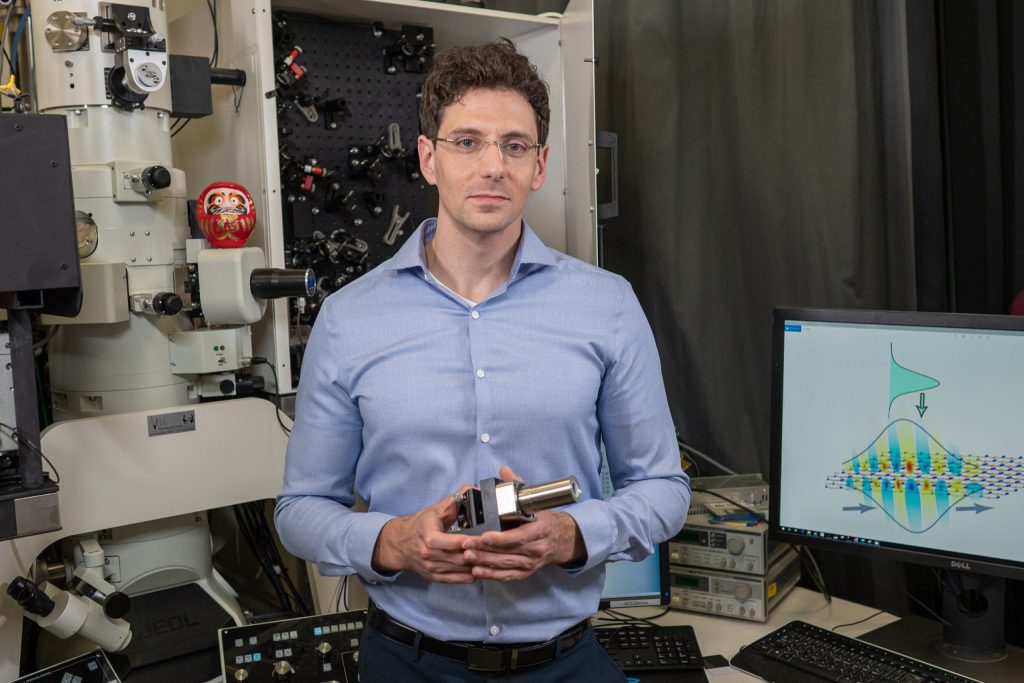
Since antiquity, mathematicians have searched for ways to compute key mathematical constants – foremost among them π, the ratio between a circle’s circumference and its diameter, which cannot be precisely represented as a ratio of whole numbers. As early as ancient Egypt (16th century BCE), approximate values of π were used for measuring land area. Archimedes (3rd century BCE) was among the first to develop a method for approximating the constant, and over the generations additional approaches emerged. These include the Indian mathematician Madhava (14th century CE), scientific giants such as Euler, Newton, Leibniz, and Gauss, and the mathematical genius Srinivasa Ramanujan (20th century) – after whom the Ramanujan Machine research group, led by Prof. Ido Kaminer of the Andrew and Erna Viterbi Faculty of Electrical and Computer Engineering at the Technion, is named.
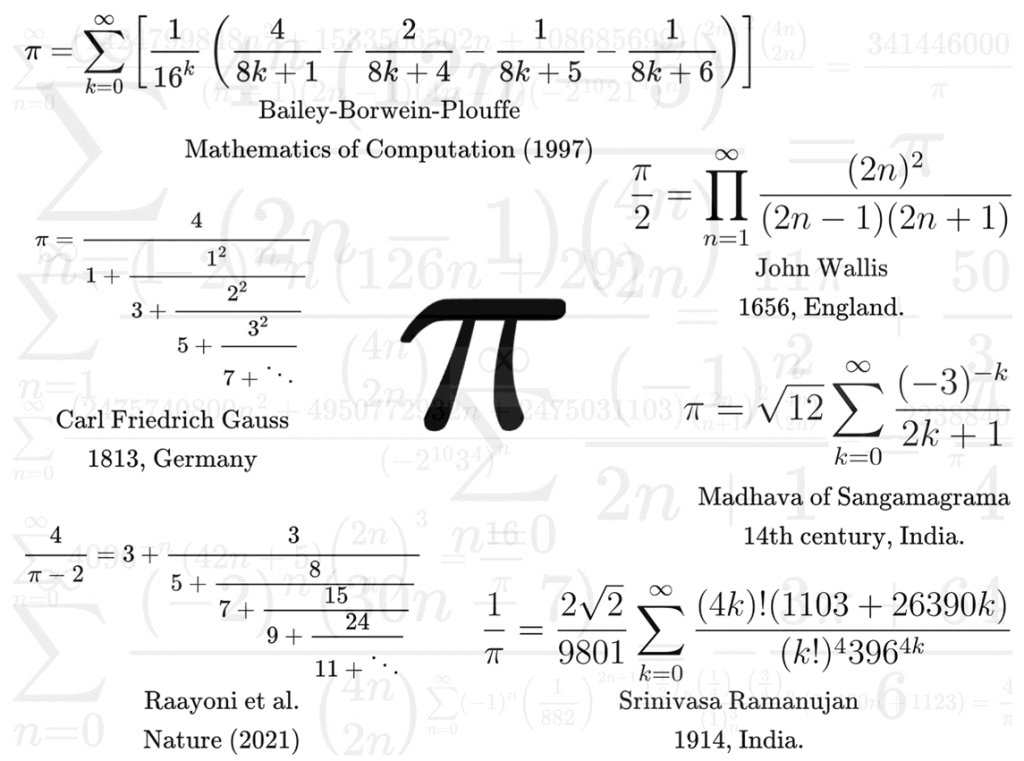
Although π and other constants have fascinated mathematicians for thousands of years, no single theory has yet been found that explains the full collection of formulas accumulated over time. This reflects a common challenge in science and mathematics: human knowledge is built as a patchwork of separate discoveries, while the internal links between them often remain hidden.
A new study by the Ramanujan Machine group – soon to be presented at NeurIPS, the world’s largest conference on artificial intelligence and computational learning – demonstrates how AI can help unify different theories in science. The research proposes a new mathematical approach: using artificial intelligence to identify connections between mathematical formulas, and shows how effective this approach is for uncovering hidden mathematical principles.
The development of the system was led by Tomer Raz, a member of the prestigious “Bareket” academic reserve program and a master’s student supervised by Prof. Ido Kaminer. The study also included Ramanujan Machine group members Michael Shalyt, Dr. Elyasheev Leibtag, Rotem Kalisch, Shachar Weinbaum, and Dr. Yaron Hadad.


The system combines UMAPS – an innovative mathematical algorithm – with large language models (LLMs). Based on more than 455,000 scientific papers, the system identified thousands of formulas for calculating the constant π, filtered them down to 385 unique formulas, and demonstrated that most of them (94%) are interconnected. In doing so, the Ramanujan Machine group achieved an unprecedented breakthrough: discovering a unifying thread between various “classical” formulas such as those of Madhava, Euler, and Gauss. The researchers found that many ancient formulas are also connected to “modern” ones, including new formulas discovered in recent years by algorithms developed by the Ramanujan Machine group. According to Prof. Kaminer, “We expect that further improvements to the system will make it possible to classify all π formulas into a small number of categories, thereby creating a unified theory. Looking ahead, our approach could help map connections in additional areas of mathematics and other scientific fields. This is especially important in an era when the amount of knowledge is growing at an enormous rate.”
The research was supported by the Schmidt Sciences Foundation (Schmidt Sciences, LLC).
Authors of the paper: Tomer Raz, Michael Shalyt, Dr. Elyasheev Leibtag, Rotem Kalisch, Shachar Weinbaum, Dr. Yaron Hadad, and Prof. Ido Kaminer.
For the full article, click here