


25 Years Since the Invention That Changed the World of Data Storage
The Technion hosted Dov Moran, inventor of the USB Flash Drive
Last week, the Technion marked 25 years since the invention of the portable storage device – the Disk On Key – in a special event with Technion alumnus Dov Moran, the inventor of the USB flash drive. The patent for the Disk On Key was approved on November 14, 2000, and shortly afterward, it was revealed to the public. Marketing to the general public began on December 15. The original storage capacity was 8MB for the basic model and up to 32MB for the premium version. Today, the maximum capacity for a USB drive of the same size is 4 terabytes—one million times more storage!
Dov Moran, a graduate of the Andrew and Erna Viterbi Faculty of Electrical and Computer Engineering, is a serial entrepreneur, an honorary doctorate recipient from the Technion, and one of the most influential Israelis in the global high-tech industry. In 2015, he received the IEEE Reynold B. Johnson Data Storage Device Technology Award. The 20,000 Edward Rhein Award he received in 2012 was donated by Moran to the Technion.
Moran founded M-Systems in 1989 to develop storage systems based on the advantages of rewritable flash memory. The Disk On Key was launched by the company in 2000 and quickly replaced CDs as a primary means for storing and transferring data. In 2006, M-Systems was acquired by SanDisk for $1.6 billion.
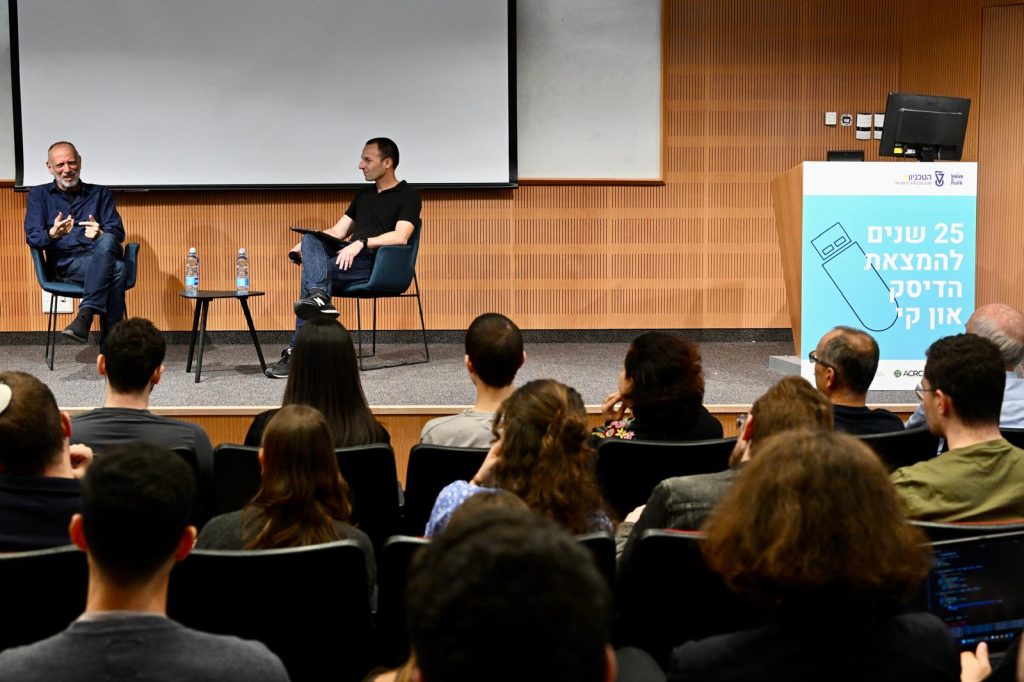
In a conversation with Prof. Shahar Kvatinsky, a faculty member at the Viterbi Faculty of Electrical and Computer Engineering, Moran spoke about his studies at the Technion, the companies he founded, and entrepreneurship as a way of life. Many of the students in the audience were not yet born when the USB flash drive entered the market.
Moran recounted the establishment of his first company, M-Systems, in the late 1980s. “At that time, very few companies were being founded in Israel each year. During the day, I worked in outsourcing and subcontracting to make a living, and at night, I worked on my own developments. In other words, I had no time to sleep. Through my work, I flew to the United States, where I learned about data storage in military systems and realized that the storage solution was static memory with no moving parts—flash memory.
“The specific idea for the Disk On Key is also connected to something that happened to me in the U.S. I was supposed to give a presentation, and my laptop battery was about to die. Someone offered me their computer, but I had no way to transfer my presentation to it. At that moment, I decided I would never again go to a presentation without a backup in my pocket. That was the motivation for developing the USB flash drive.
“If the current Dov Moran, the venture capitalist, were to meet the young Dov Moran, he wouldn’t invest in him. At that stage, I made many mistakes, but I don’t regret them because failure is part of the learning process, and it’s important to remember that every failure is a lesson.”
In response to Prof. Kvatinsky’s question about the AI era, Moran replied: “It really is a crazy revolution. I view technological development as a cyclical process built on a reciprocal relationship between infrastructure and applications. About fifty years ago, the personal computer was invented, and then countless applications were developed for it. This created the need for computer-to-computer communication, leading to the invention of Ethernet, which in turn enabled new applications. When demand arose for connections between organizations and between countries, the Internet was invented. But local communication required strong, broad infrastructure, and that’s how the cloud was born. The same is true for the AI revolution. It will require the development of new infrastructures and will lead to innovations. What particularly interests me is the intersection of AI and health tech, because the field of medicine lags behind technology, and this gap prevents significant medical breakthroughs.”
In response to a question about his message to students, Moran said, “In the end, we succeeded back then because we were experts in flash technology. We read extensively and knew what others were doing, so all that remained was to connect the dots. And that’s my message to you, the students: invest in learning, go deep, acquire deep knowledge. Pursue advanced degrees and don’t scatter your focus. If you want to become an entrepreneur, that’s fine, but it might be better to first work in a large company to understand how things work; otherwise, you’ll have to learn that in the startup you found, and that kind of learning carries a heavy price. It’s also important to remember that entrepreneurship requires hard work, risk-taking, and an imbalance between family and work life, and it’s not for everyone. Ultimately, entrepreneurship is a kind of itch, and I’m very itchy.”
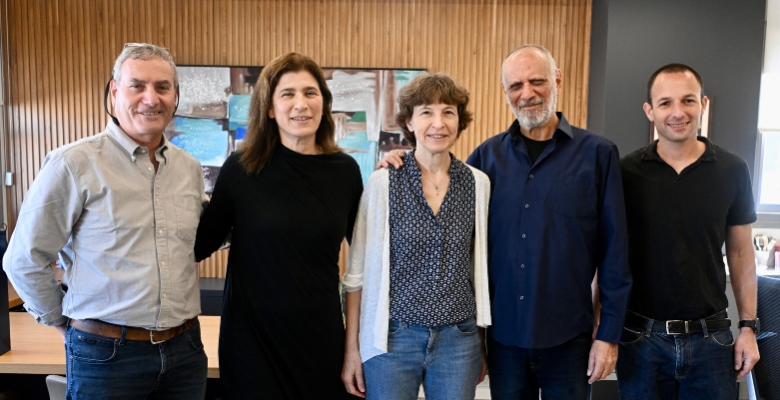
During his visit to the Technion, Moran toured the Viterbi Faculty of Electrical and Computer Engineering and held meetings with Prof. Yuval Garini, the Technion Vice President for Innovation and Industry Relations; Prof. Lihi Zelnik-Manor, Vice President for External Relations and Resource Development; Prof. Idit Keidar, dean of the Faculty; and leading Technion researchers and entrepreneurs.
Photo credit: Rami Shlush, Technion Spokesperson’s Office.


