


No Pressure
New Technion technology could enable blood pressure measurement without an inflatable cuff
A tiny sensor could one day measure blood pressure continuously, comfortably, and accurately without an inflatable cuff. The device was developed by Prof. Amir Rosenthal and Prof. Daniel Lange of the Technion’s Andrew and Erna Viterbi Faculty of Electrical and Computer Engineering, together with doctoral student Gil Gelbert. They published their findings in Nature Communications.


Blood pressure is one of the most important indicators of cardiovascular health, yet in most cases it is still measured using an inflatable cuff that provides a reading at a single point in time. The researchers’ device is a tiny wearable sensor that measures blood pressure continuously, without a cuff or any action required from the user.
The device is based on silicon photonics and optoacoustic technology. Short pulses of light generate ultrasound waves inside an artery, while a tiny sensor called SPADE measures both the artery’s absolute diameter and its minute changes with each heartbeat. These measurements can be used to reconstruct the full blood pressure waveform and estimate blood pressure in real time and over extended periods.
By measuring the artery’s absolute diameter for the first time using this miniature sensing approach, SPADE overcomes a major limitation of earlier technologies. Combined with sophisticated AI-based modeling of arterial behavior, this capability provides a more complete basis for accurate, continuous blood pressure estimation.
One of the system’s main advantages is its simplicity. Unlike many approaches that require complex arrays of sensors and precise placement on the body, the new technology uses a single, tiny sensing component and is relatively tolerant of changes in the sensor’s position and angle. In proof-of-concept tests with volunteers, the system produced promising results, capturing blood pressure waveform characteristics at a rate of 100 measurements per second.
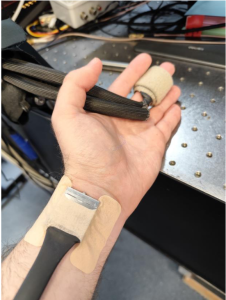
The researchers believe the technology could eventually be incorporated into smartwatches, medical patches, and other wearable devices. This would allow users to monitor their blood pressure continuously at home, at work, and during daily activities, providing information that could improve the monitoring of people with cardiovascular disease.
Ron Moisseev, Yoav Hazan, and Tamar Harary also participated in the study. It was supported by the Israel Innovation Authority, the United Israel Appeal, and the Ollendorff Minerva Center for Vision and Image Sciences at the Technion (OMC).
Read the article in Nature Communications
Photo credit: Technion Spokesperson’s Office


