


First Experimental Evidence Shows Strong Stellar Magnetic Fields Suppress Coronal Mass Ejections
An international team of astrophysicists and plasma physicists has provided the first experimental evidence that strong magnetic fields surrounding active stars can completely suppress coronal mass ejections (CMEs), helping to explain one of the longstanding mysteries of stellar astronomy: why CMEs are rarely observed on stars other than the Sun.
CMEs are giant eruptions of magnetized plasma that play a major role in shaping stellar evolution, driving mass and angular momentum loss, and influencing the space weather environments of orbiting planets. While they are routinely observed on the Sun, convincing detections around other stars have remained surprisingly scarce.
To investigate what that is, researchers combined astrophysical simulations, high-energy laser-plasma experiments, and advanced three-dimensional magnetohydrodynamic modeling. The team recreated key conditions of stellar CMEs in the laboratory and observed how plasma flows behaved under increasingly strong magnetic fields.
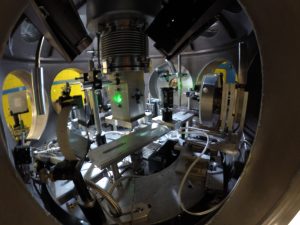
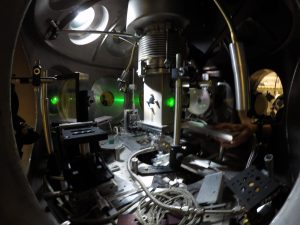
The laboratory set-up at the Ecole Polytechnique (France), where the experiments for recreating stellar eruptions were performed. Shown is the inside of the vacuum target chamber where the plasmas are created, with, at the center, the magnetic field coil that allows to re-create the strong magnetic fields that are scaled to those of a young star.
The experiments revealed a clear transition: under weaker magnetic fields, plasma streams propagated freely, while stronger fields caused the flows to become unstable, fragment, and eventually stop altogether. Numerical simulations identified magnetic kink instabilities as the mechanism responsible for disrupting the plasma and preventing its escape. The laboratory results closely matched astrophysical simulations, showing that a stellar magnetic field of about 100 gauss can effectively confine CME-like eruptions.
The study was led by an international collaboration that included researchers from the Leibniz Institute for Astrophysics Potsdam (AIP), Germany, and Prof. Julien Fuchs of École Polytechnique and the Technion-Israel Institute of Technology.

The research was supported by the European Research Council (ERC) Project GENESIS, ELI-NP, the Romanian Ministry of Research and Innovation, the U.S. National Science Foundation (NSF), and major French and European high-performance computing infrastructures.


