


The Flat Side of Evolution: Even When Multiple Evolutionary Paths Are Equally Advantageous, the Choice Among Them Is Not Random
A surprising discovery by Technion researchers sheds new light on the dynamics of evolution. Published in the Proceedings of the National Academy of Sciences (PNAS), the study shows that when an organism has several evolutionary paths available with equal fitness, the path it follows is not necessarily chosen at random.
The research was led by Razi Fachar Eldeen of the Faculty of Mathematics and Prof. Naama Brenner of the Wolfson Faculty of Chemical Engineering, both of whom are members of the Technion’s Network Biology Research Laboratory.


According to Prof. Brenner, “Evolution is commonly described as a process of climbing fitness peaks, in which organisms become better adapted to their environment and thus improve their chances of survival. However, organisms sometimes face multiple evolutionary trajectories that all yield the same level of fitness. This raises the question of how evolution selects among these paths of equivalent fitness.”
The Technion researchers found that the choice is not random. Rather than wandering aimlessly, populations deterministically drift toward flatter regions of the evolutionary landscape, where an organism’s traits are more robust to mutations and other perturbations. In other words, when fitness is equal, evolution tends to favor directions that confer greater robustness and tolerance to change, properties that themselves provide a survival advantage.
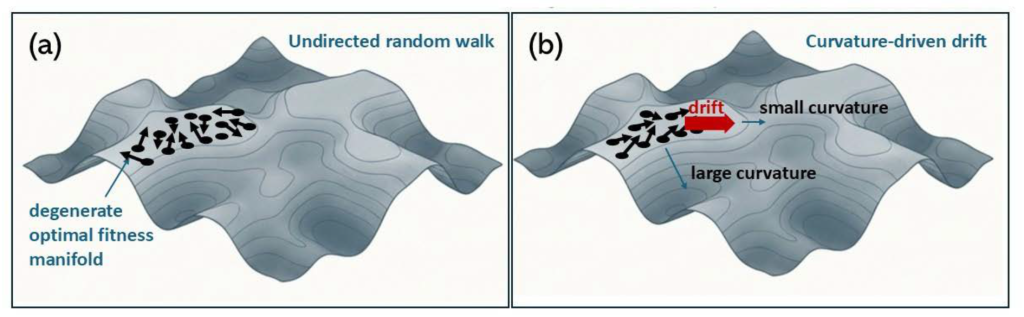
The findings suggest that biological robustness and resilience to disruption can emerge spontaneously through evolutionary dynamics, even in the absence of direct selection favoring these traits.
The study may have broad implications for understanding the evolution of complex biological systems. It could help explain patterns of biological variation observed in nature, deepen our understanding of the origins of robustness in living systems, and build conceptual bridges between evolutionary biology and fields such as deep learning, where neural networks likewise tend to converge on flat minima that promote better generalization.
The research was supported in part by the U.S.-Israel Binational Science Foundation (BSF).


