

Concrete Structures Rise in Seconds
Technion and Columbia researchers unveil a self-deploying reinforced concrete system that dramatically reduces construction time, cost, and environmental impact
Researchers from the Technion Faculty of Mechanical Engineering, together with colleagues from Columbia University, have developed an accelerated method for constructing reinforced concrete structures. Instead of transporting large formwork systems to construction sites, assembling them manually, and dismantling them after the concrete has cured, the new system arrives in a compact configuration and automatically deploys into its full shape during the concrete casting process.
The research was led by Prof. Amir Gat and doctoral student Ezra Ben-Abu, with participation from Dr. Anna Zigelman of the Technion and Prof. Hod Lipson, a Technion alumnus and chair of the Department of Mechanical Engineering at Columbia University. The paper was published in Communications Engineering, and it was selected for a research highlight in Nature Cities.


The researchers demonstrated the construction of a reinforced concrete structure measuring 2.36 meters in height with a 2.4-meter base diameter, which deployed completely in just 14 seconds. The structure was built using multistable tubes integrated in advance with steel cables that serve as the concrete’s internal reinforcement.
Formwork is among the most expensive, cumbersome, and environmentally damaging components of concrete construction. According to the engineering literature, formwork can account for up to 75% of construction time and 60% of total project costs. The researchers’ new technology enables compact formwork units to be transported to the construction site, where liquid concrete is poured through a single inlet. The pressure of the concrete causes the multistable tubes to unfold automatically into their predetermined geometry, eliminating the need for manual assembly on site. The researchers demonstrated a variety of geometries, including rectangular, conical, and spherical structures, and also proposed a modular approach for constructing multistory buildings.
Load-testing experiments showed that the thin polymer shell of the tubes not only serves as permanent formwork but also significantly enhances structural performance. The researchers found that the shell increased the load-bearing capacity of concrete columns by approximately 200% compared with identical columns from which the shell had been removed. In addition, the tested columns satisfied the requirements of the ASTM C39 standard for concrete.
The technology could have significant economic and environmental benefits. According to calculations presented in the study, manufacturing the new formwork could reduce carbon emissions associated with formwork production by approximately 50% compared with conventional industrial wooden formwork. The economic advantage is equally substantial: the material cost of the new formwork is approximately 94% lower than that of traditional wooden formwork – about $11 per cubic meter of concrete, compared with approximately $193 for conventional systems. Additional savings are expected through reduced assembly, dismantling, and transportation requirements.
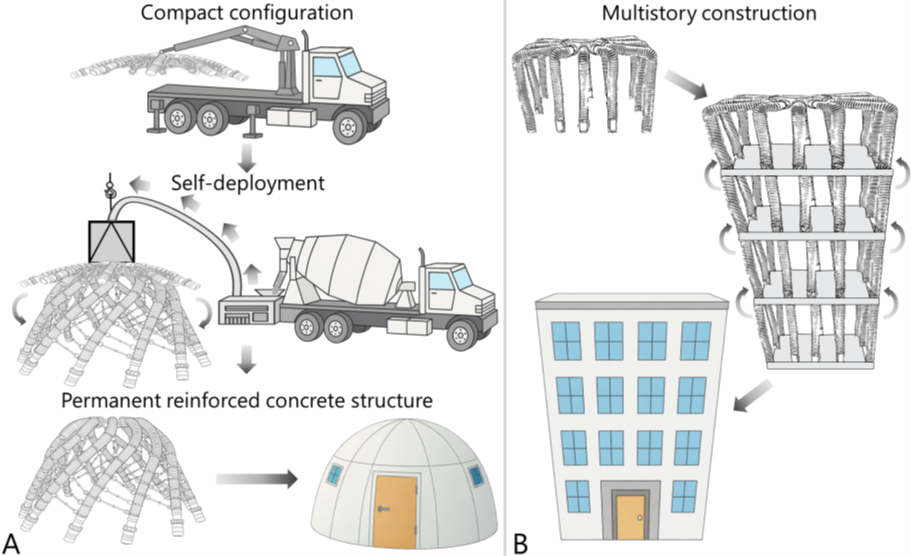
Right: Concept for modular construction of multistory buildings using the same technology.
Although the work currently represents a proof-of-concept, the researchers believe the technology could be applied to a wide range of applications, including the rapid construction of buildings and infrastructure, projects in remote or difficult-to-access locations, emergency housing following natural disasters and wars, large-scale infrastructure projects requiring fast and repetitive construction, complex architectural structures, reduced construction waste, and lower reliance on timber for temporary formwork.
The research was supported by the Azrieli Foundation through an Azrieli Fellowship awarded to doctoral student Ezra Ben Abu. Alongside publication of the paper, a U.S. provisional patent application covering the technology was filed jointly by Columbia University and the Technion Research & Development Foundation (TRDF).
Paper: https://www.nature.com/articles/s44172-026-00725-1
Nature Cities research spotlight:
https://www.nature.com/articles/s44284-026-00499-9
Demonstration of the new technology: Self-Deploying Reinforced Concrete Structures