

Life-Saving Technologies
At the annual CS HACK DOING GOOD hackathon held recently at the Technion, students presented technological solutions to emergency response and rescue challenges
This year’s CS HACK DOING GOOD hackathon focused on developing technological solutions for emergency response and rescue scenarios, inspired by today’s realities and the growing need for tools that support real-time decision-making, coordination among emergency agencies, and the management of complex, rapidly evolving situations. Hosted by the Henry and Marilyn Taub Faculty of Computer Science at the Technion, the event was organized in close collaboration with leading emergency organizations, including Israel Fire and Rescue Services, the Lehava Unit, the Home Front Command, Israel Police, the Ministry of Health, Magen David Adom (MDA), and Rambam Health Care Campus. The goal was to develop practical solutions tailored to operational needs in the field.
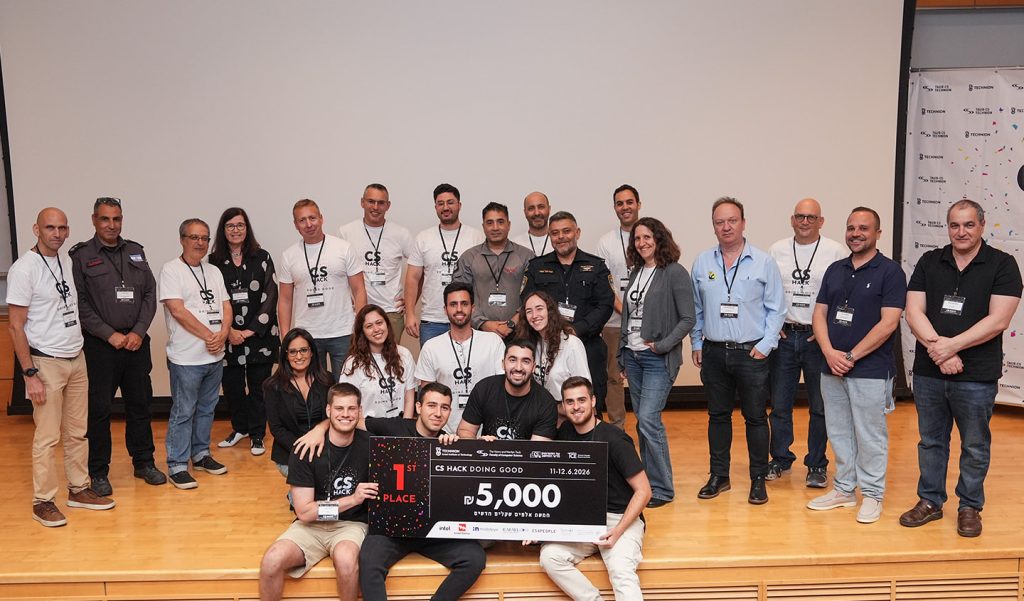
Twenty-five projects reached the final stage, each presenting a working proof of concept. The winning teams were:
First Place: Matan Gerstman, Rotem Harel, Yoav Fuchs, and Yanai Zehavi developed a system that uses Bluetooth signals from mobile phones to locate missing persons during emergencies such as earthquakes.
Second Place: Ofek Amir, Tammy Ashour, Ori Pardo, Dor Mandel, and Tal Ben Ami developed DOMINO, a hands-free documentation system powered by voice technology and artificial intelligence. The system transfers real-time information from the field to hospitals and command centers, helping eliminate operational bottlenecks.
Third Place: Ofek Israel, Amir Sorani, Yair Yanni, and Avner Mondshine developed a decision-support system for water search-and-rescue operations. The system generates a real-time probability map and an optimal search plan for rescue teams.
Judges’ Choice Award: Eden Avidan, Roy Carmel, Linoy Geva, Shir Belson, and Naor Shoicht developed ADAR, named in memory of Adar Ben-Simon, who was killed on October 7 while defending the Zikim military base and was Eden Avidan’s cousin. The system is designed to locate missing persons in open areas. Based on the last known location and terrain conditions, it generates a dynamic probability map and directs autonomous drones to scan the area and continuously update the map in real time until the missing person is found.
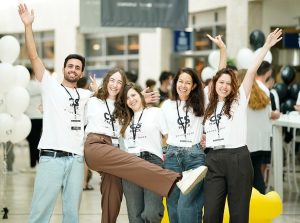
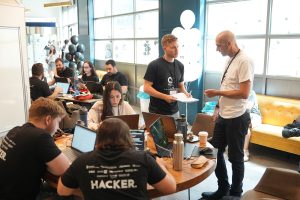
The hackathon was organized by the Henry and Marilyn Taub Faculty of Computer Science under the leadership of student organizers Eden Algoy, Keren Losev, and Glaor Lazar, together with Ortal Kostin and Noa Mor from the Faculty’s External Relations and Industry team. Some 140 undergraduate and graduate students participated, alongside dozens of mentors from industry and emergency organizations. During approximately 30 consecutive hours of work, the students developed innovative prototypes under close professional guidance, aiming to create solutions with genuine practical potential.

The hackathon opened with remarks by the Dean of the Faculty of Computer Science, Prof. Eyal Kushilevitz, and Dr. A., head of the Algorithms Department at Rafael’s Tel Aviv Development Center. They were followed by a keynote lecture from retired Police Commissioner Roni Alsheikh, former commissioner of the Israel Police. Titled Hack the Chaos, the lecture explored situational awareness and decision-making under chaotic conditions such as earthquakes, cyberattacks, and wars.
“When chaos erupts,” Alsheikh said, “we try to bring order to it by creating an organizing framework: What is the current situation? What should we do? How do we prioritize possible responses? For example, if someone is trapped beneath rubble, rescuing that person clearly takes precedence over other objectives. These priorities also change over time. During hurricanes in the United States, for instance, cellular communications can become just as critical as the immediate supply of water. And if there is no cellular network, what alternatives can provide communication? At the Nova music festival, it was critically important which direction people fled – whether they escaped the trap or ran into it. Ultimately, as a decision-maker, your goal is to guide the public toward life-saving behavior, and technology plays a central role in making that possible.”
The judging panel on Friday included Dean of Undergraduate Studies Prof. Benny Kimelfeld, Dean of the Faculty Prof. Eyal Kushilevitz, Haifa Deputy Mayor Yossi Shalom, and additional representatives from industry and emergency response organizations.
The hackathon was supported by Rafael, Intel, Mobileye, the Israel Electric Corporation, the Social Incubator, the Technion Tech AI Center, and a donation from KLA.
A full list of the challenges, mentors, and judges is available on the hackathon website: https://www.cshack-technion.com/