

Solar Storms Around a Black Hole
Researchers from the Technion Faculty of Physics have discovered that the powerful eruptions occurring in the coronae of black holes are driven by dynamics similar to those of solar storms
Technion researchers have presented evidence for the existence of solar-storm-like outbursts near supermassive black holes, which can be a million times larger than the Sun or more. The phenomenon was discovered in the vicinity of the black hole in the galaxy NGC 3783 and the researchers’ findings were published in The Astrophysical Journal Letters.
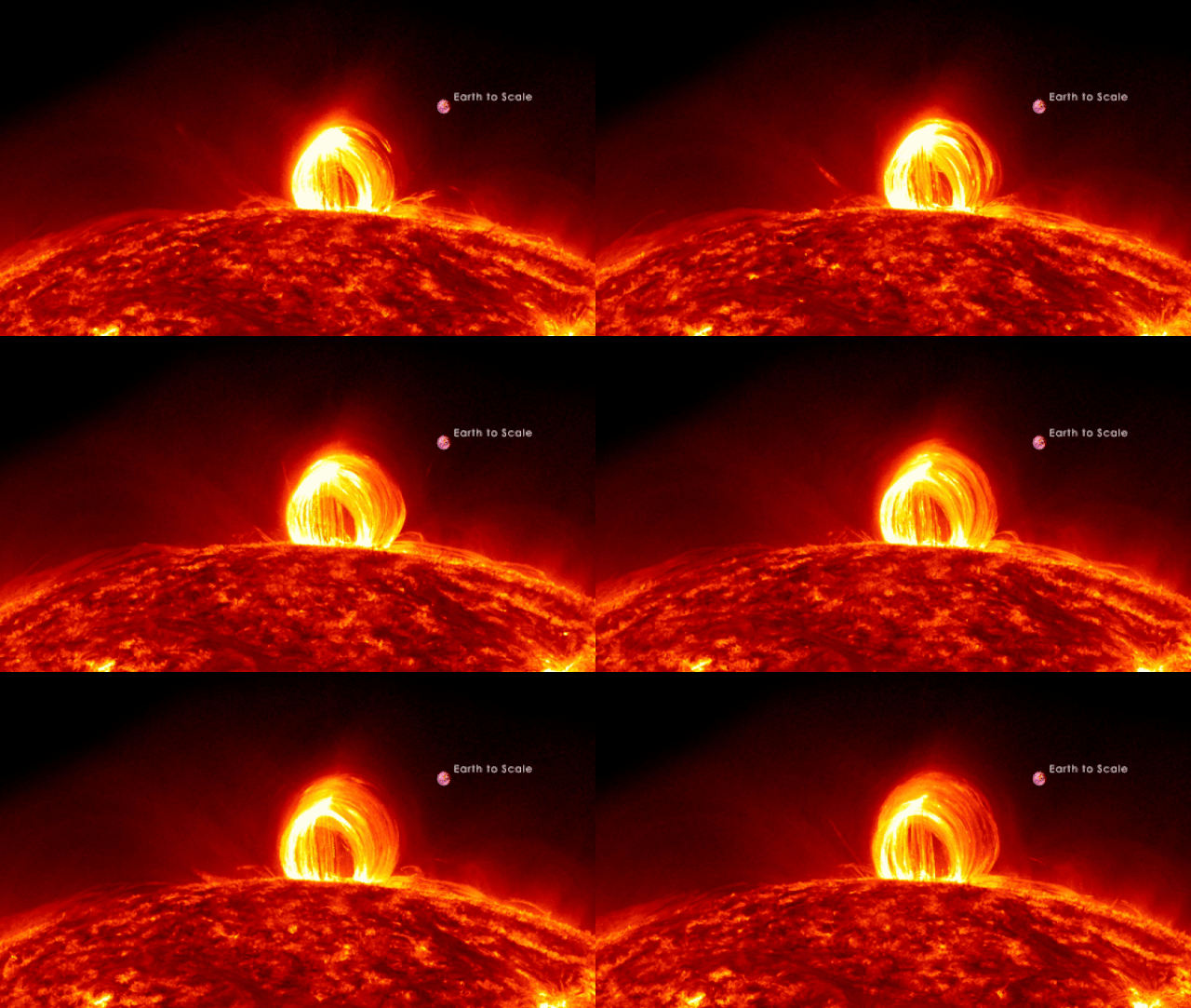
Solar storms are powerful eruptions of X-ray radiation accompanied by winds of charged particles ejected from the Sun’s corona into the solar system, posing risks to astronauts and satellite communications. These Coronal Mass Ejections (CMEs) originate in the conversion of magnetic energy into kinetic energy through a process called magnetic reconnection. Technion researchers have discovered, for the first time magnetic reconnection eruptions and a CME in the coronae of a black hole.

In this study, the researchers monitored X-rays emitted from near the black hole using the XRISM space telescope. The phenomenon they identified near the black hole is known as the “Neupert effect.” It was first discovered on the Sun in 1968 but had never previously been observed around black holes. This means that the same physical processes underlying solar storms also occur in the environments of supermassive black holes.
The research was led by Gal Vardi, a doctoral student in the Technion Faculty of Physics, under the supervision of Prof. Ehud Behar, with the participation of researchers from Japan, Europe, and the United States. The observations were conducted using the XRISM space telescope, a joint mission of NASA, the Japan Aerospace Exploration Agency (JAXA), and the European Space Agency (ESA), as well as ESA’s XMM-Newton space telescope.
In the link: Flow along magnetic field lines
https://cdn.mos.cms.futurecdn.net/Kigkno5FGn6xnkEmzAqTzR.gif
The paper:
https://iopscience.iop.org/article/10.3847/2041-8213/ae8f44/pdf